
On this page
- Quick answer
- The 2026 calendar
- 12 January, youth pledge
- 31 May, tobacco drive
- 26 June, World Drug Day
- 12 August, drug free youth
- 1 October, blood donation
- 10 October, mental health
- Between the rally days
- Free family counselling
- What we did not do
- Why young people start
- Why Kullu, Manali, Mandi
- The centre behind it
- What treatment costs
- Where we work
- Questions families ask
- Sources
Eshan Charitable Trust ran six public anti drug campaigns in Kullu and Manali through 2026, with outreach carrying into Mandi: a college rally and pledge on 12 January, an anti tobacco drive on 31 May, a rally and press event on World Drug Day on 26 June, college and village outreach on 12 August, a voluntary blood donation camp on 1 October, and family counselling sessions on 10 October for World Mental Health Day.
Between those dates the team runs college sessions, village and panchayat meetings, and free counselling for families who ring. The treatment side of it is our residential nasha mukti kendra in Kangra, which is psychiatrist led, registered as a charitable trust, and takes men from Kullu, Manali, Mandi and the rest of Himachal, with fees starting at ₹12,500 a month.
Six dates on a calendar. Two valleys that keep showing up in the state's drug seizure reports, and a third district next door that is going the same way. This page is a plain account of what was done in Kullu and Manali in 2026, what each day was actually for, and what families could take from it.
Most pages about drugs in this valley open with frightening numbers. Those numbers are real, and they are at the end of this page with their sources, because the work comes first.
Published by Eshan Charitable Trust, a registered charitable trust running a drug de addiction and nasha mukti kendra in Kangra. Our campaign work is in the Kullu valley and Mandi. Our residential centre is in Kangra, near Dr RPGMC Tanda, and we say so plainly rather than listing a Kullu address we do not have. We are not a government body.
The 2026 Campaign Calendar in Kullu and Manali
Each date was picked because it already means something, so the conversation starts before anyone has said a word. A rally on a random Tuesday gets ignored. A rally on World Drug Day gets a press photographer.
| Date | Campaign | Main activity | Why that date |
|---|---|---|---|
| 12 January 2026 | Youth Against Drugs | College rally and pledge | National Youth Day |
| 31 May 2026 | Anti Tobacco Awareness | Public awareness drive | World No Tobacco Day |
| 26 June 2026 | World Drug Day | Anti drug rally and press event | International Day Against Drug Abuse and Illicit Trafficking |
| 12 August 2026 | Drug Free Youth | College and village outreach | International Youth Day |
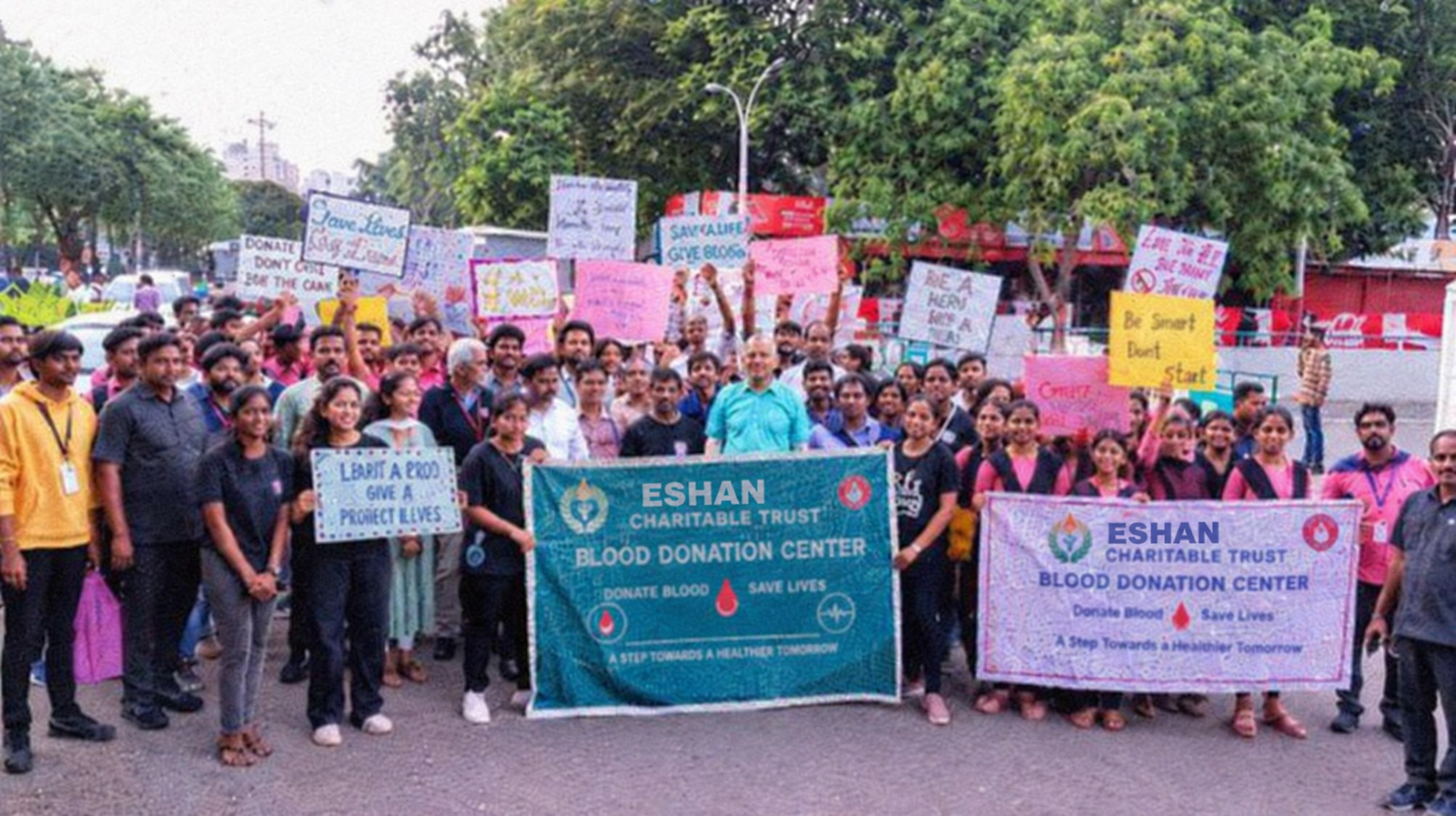
| 1 October 2026 | Blood Donation Day | Voluntary blood donation camp | National Voluntary Blood Donation Day |
| 10 October 2026 | Mental Health and Recovery | Family counselling and awareness | World Mental Health Day |
Public campaigns run by Eshan Charitable Trust across Kullu, Manali and Mandi during 2026.
What follows is each one in turn, with what it was meant to do and what it actually did.
12 January: Youth Against Drugs, the College Rally and Pledge
Youth Against Drugs
National Youth Day- Where
- Kullu and Manali colleges
- Activity
- Rally and public pledge
- Audience
- Students, staff, NSS and NCC volunteers
The year opened on Swami Vivekananda's birth anniversary with a student rally and a pledge taken out loud, which is the format colleges across the state use for anti drug work and which students take part in willingly.
What it was really for: the twenty minutes after the pledge, when two or three students always hang back with a question they will not ask in front of a hall.
A pledge on its own changes nothing. Anyone who has worked in this field knows that. What a pledge does is give a room permission to talk about something that is usually only whispered about, and that is worth a morning.
The session itself is not a lecture about morals. It is specific. What chitta actually is, which is adulterated heroin and not a party drug. What the first two weeks of use feel like, which is the reason people say it is not a problem. What the fourth week feels like, which is the reason they stop saying that. And the thing almost nobody in a college hall knows, which is that chitta withdrawal is a medical event, not a test of character.
We also give students something practical to take away: the signs that a friend has started. Weight dropping, money going missing, sleep inverted, a new circle of friends nobody has met, long sleeves in summer. Students spot these months before parents do, and a friend who acts early is worth more than any rally.
Nobody is asked to report anyone. They are asked to tell a friend to call a number, and the number is free.
31 May: The Anti Tobacco Drive
Anti Tobacco Awareness
World No Tobacco Day- Where
- Public spaces, Kullu and Manali
- Activity
- Street awareness drive
- Focus
- Tobacco as the first step
A street level drive in the busiest parts of both towns, talking to shopkeepers, taxi drivers, hotel staff and school age boys about tobacco, and about where tobacco tends to lead in this particular valley.
Why a de addiction trust cares about cigarettes: ask any resident in our centre what came first. It is almost never chitta.
This is the campaign people question the most. A drug rehabilitation trust spending a day on cigarettes looks like a soft target.
It is not. In this valley the sequence is depressingly consistent. Cigarettes at fourteen or fifteen, because everyone in the group smokes and it costs ten rupees. Charas by sixteen, because it grows on the hillside behind the house and three generations have treated it as normal. Then, for a certain number of them, chitta. Each step feels tiny from where the person is standing, and the last one is a cliff.
So we work at the first step, where the conversation is still easy and nobody is defensive. We talk to the paan shop near the school. We talk to parents who have decided that a cigarette is a small thing compared to what the neighbour's son is on. It is a small thing, until you understand what it is usually the first of.
If someone in your house has already moved past tobacco and on to charas, our page on bhang and charas addiction symptoms explains what dependence on it actually looks like, and bhang and charas detox covers the treatment side.
26 June: World Drug Day, the Biggest Day of the Year
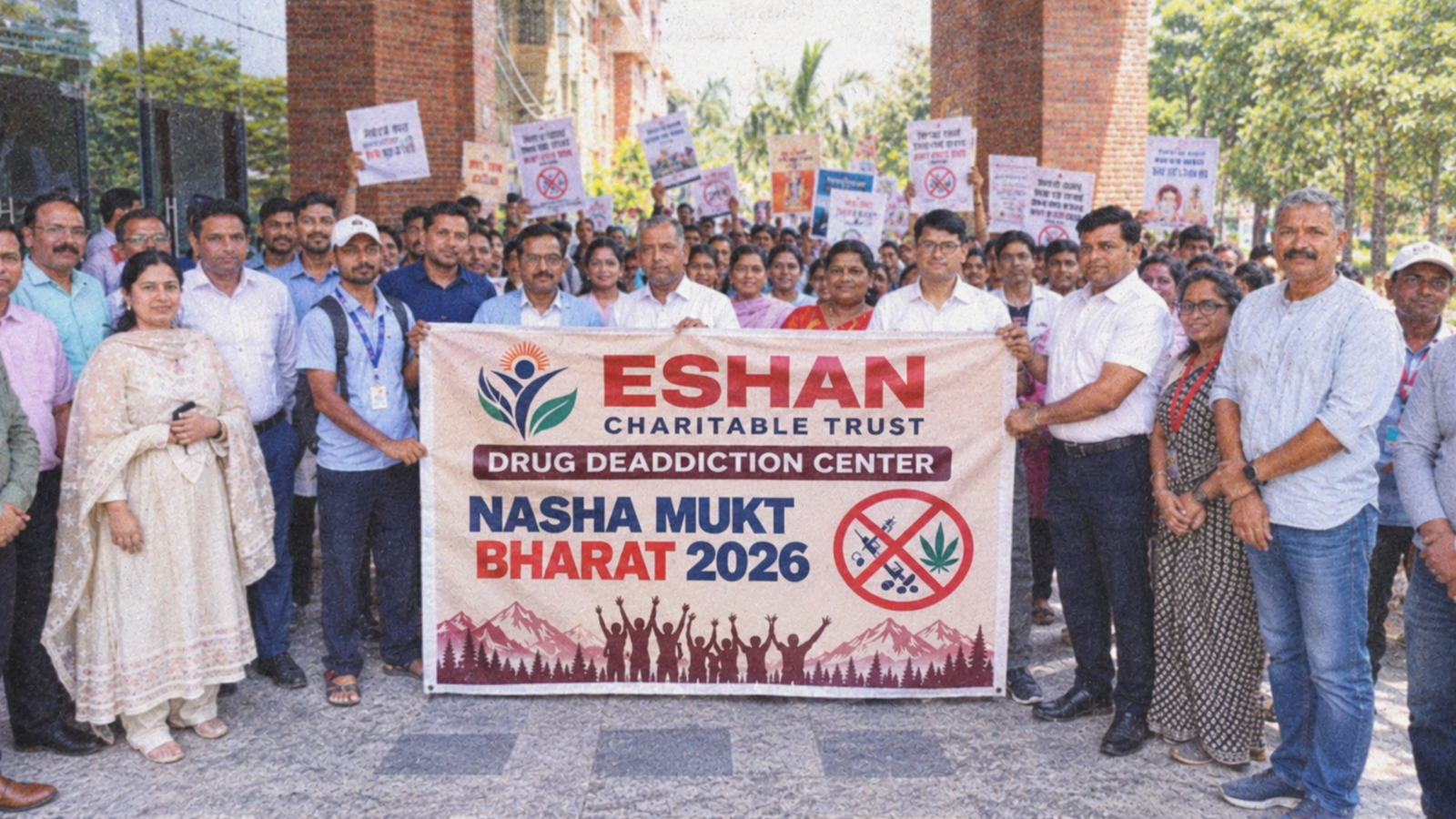
World Drug Day rally and press event
26 June- Where
- Kullu and Manali, main town routes
- Activity
- Anti drug rally
- Plus
- Press interaction
The International Day Against Drug Abuse and Illicit Trafficking is the one date in the year when a drug story will definitely be printed, so it is the one day when a small trust can reach an entire district rather than one college hall.
The message to press, in one line: treatment exists, it is affordable, and hiding it at home is what kills people, not the shame of being seen walking into a centre.
The rally is the visible part. The press event is the part that works.
A rally reaches the people on the street that morning. A news item reaches the mother in a village above Banjar who has suspected something for four months and has not said it out loud to her husband yet. That woman is the whole point of the day. She is not going to attend a rally. She might read a paper, or someone might show her a post.
Three things get said every year, and they get said because families in this valley consistently believe the opposite:
- Addiction is treated by doctors, not by willpower, not by beating, and not by locking a boy in a room for a month
- There are free government options in Kullu district, and a family with no money is not out of options
- A relapse is not the end of treatment, it is a normal and expected part of it, and it is a reason to go back rather than to give up
On the free government side we point people to the real thing rather than to ourselves. Kullu district has an AIIMS supported Addiction Treatment Facility at Bhuntar and services at Regional Hospital Kullu, and we have written both up honestly in our guide to the government nasha mukti kendra options near Manali and the wider list of every government nasha mukti kendra in Himachal Pradesh.
12 August: Drug Free Youth, Colleges and Villages
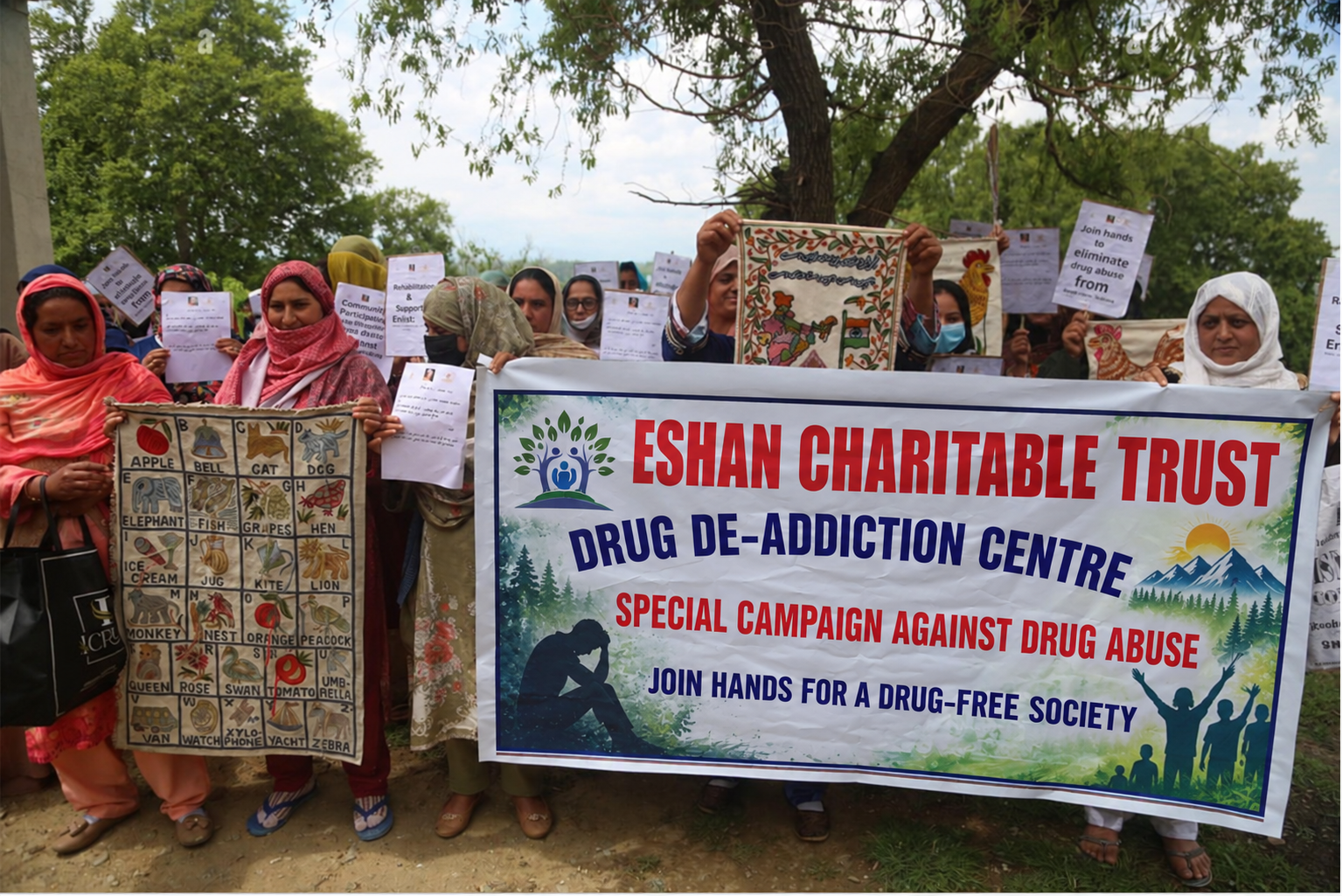
Drug Free Youth outreach
International Youth Day- Where
- Colleges and villages, Kullu valley
- Activity
- Sessions, marches, door level talk
- Joined by
- Mahila mandals, panchayat members
Held on International Youth Day, ten days after the national Nasha Mukt Yuva campaign was launched on 2 August 2026 as a hundred week countrywide youth drive, which gave the village sessions a bigger frame to sit inside.
What changed this one: going into villages rather than only colleges, because the boys who have already dropped out of college are the ones most at risk and least reachable.
January reaches students. August reaches the ones who are no longer students, and that is a harder and more important room.
A young man who finished school, did not get into anything, did two seasons of hotel work and is now at home between seasons is the profile that worries us most in this valley. He has time, a little cash from the season, a group of friends in the same position, and nothing in the calendar until April. Nobody is looking for him.
In village sessions the audience is mostly women, and that is not an accident. Mothers, aunts and mahila mandal members notice the change first: appetite gone, sleeping all day, the locked bathroom, the jewellery that is suddenly not in the almirah. What they lack is not observation. It is a sense of what to do next that is not shouting or hiding it.
So the village session is mostly practical. What to say the first time. What not to say. Why an argument at 11pm with someone in withdrawal goes nowhere. How to ring a counsellor without the person knowing yet. We have written the long version of this in Hindi at ghar mein koi chitta le raha hai and chitta kaise chhode, alongside chitta chhodne ka ilaj, and we hand the same thing out on paper.
1 October: The Voluntary Blood Donation Camp
Blood donation camp
National Voluntary Blood Donation Day- Where
- Kullu and Manali
- Activity
- Voluntary donation camp
- Who came
- Public, staff, recovering residents
Held on National Voluntary Blood Donation Day, which India marks on 1 October, alongside World Blood Donor Day on 14 June. A camp, a queue, tea afterwards, and a de addiction counsellor sitting at the next table.
The reason this is on an anti drug calendar: it changes who walks up to us.
Nobody walks into a drug awareness stall in their own town. Everyone knows everyone here. Standing at that table is a public statement about your family, and people would rather carry the problem for another year than be seen doing it.
A blood donation camp has no such cost. You are a good citizen for being there. And while you are waiting for the form, or sitting with juice afterwards, you can ask the person next to you a question in a normal voice, and nobody watching learns anything about you.
That is most of why we run it. The rest of why we run it is simpler. A hill district with a highway full of accidents and a tourist season that doubles the population needs blood, and a trust with a hundred willing hands can supply some of it.
There is a third thing, and it matters more than it sounds. Men in recovery donate at these camps. Someone who has spent three years being told he is a burden on his family gives something to a stranger who will never know his name. Ask any counsellor what that does for a man in month four of recovery. Our page on what happens in a rehab centre covers why this kind of thing is treatment and not decoration, and the recovery process itself goes into the longer arc.
10 October: Mental Health and Recovery, the Family Sessions
Mental Health and Recovery
World Mental Health Day- Where
- Kullu and Manali
- Activity
- Family counselling and awareness
- Cost
- Free
The most recent campaign, and the quietest. No march, no banners. Counsellors sitting with families, one at a time, for as long as each one needed.
Why it finishes the year: almost nobody in Kullu and Manali is treating the thing underneath, and the thing underneath is usually why the first use happened.
Addiction rarely arrives on its own. Underneath it there is very often anxiety that nobody named, a depression that got called laziness, a sleep problem that has run for years, grief after a death in the family, or a job loss that took a man's standing in his own house with it. Drugs work on all of those. That is the uncomfortable truth, and it is why willpower arguments fail. The substance is doing a job.
So World Mental Health Day is spent on the family rather than on the public. What they get, free, is a proper sit down: what is actually happening in the brain, what treatment involves, what the family's role is and what it is not, and how to stop the household from organising itself entirely around one person's addiction, which is what most of these families have quietly been doing for years.
We also talk about the family's own mental health, which nobody asks about. The mother who has not slept properly in two years is also a patient, and she is not getting treated.
Two pages that came directly out of these sessions: the psychology of addiction, which explains the mechanism in plain language, and yoga for stress and anxiety, which is part of the daily routine at our centre and is something a family can start at home for nothing.
What Happens Between the Rally Days
Six campaigns is what gets photographed. It is not the work. The work is the other three hundred and fifty nine days, and it looks like this.
College and school sessions
Not only on marked days. Any college, ITI, school or NSS unit in Kullu, Manali or Mandi can ask for a session, and we come. No fee, no conditions, no sales pitch at the end.
Village and panchayat meetings
Smaller rooms, harder questions, and the place where families actually open up. Usually arranged through a panchayat member or a mahila mandal.
Free counselling on the phone
The number at the top of this page is answered day and night. Most calls are from families, not from the person using, and most of them are not about admission at all.
Referral to free government care
When a family's best option is the free Bhuntar facility or Regional Hospital Kullu, we tell them that and give them the number. We lose the admission. That is fine.
International Day of Yoga, 21 June
Yoga at 6am is part of the daily routine at the centre, so the June yoga day is a natural public extension of it rather than a one off photo.
World Blood Donor Day, 14 June, and World AIDS Day, 1 December
Two more fixed points in the calendar. AIDS awareness matters here specifically because injecting changes the risk picture completely, and almost nobody discusses it.
Follow up after discharge
Men who go home to Kullu, Manali or Mandi get followed up. The first ninety days after discharge is where relapse concentrates, and a phone call in week three is cheap insurance.
Helping families compare options
Including options that are not ours. We will go through what rehab actually costs in Himachal with anyone who asks, including what other centres charge.
None of that produces a photograph. All of it produces the calls that come six months later, usually starting with the words "you spoke at my son's college".
Free Family Counselling in Kullu, Manali and Mandi
This is the part of our work families use most, and the part they least expect to be free, so it is worth being specific about.
If you ring us about someone in Kullu, Manali, Bhuntar, Banjar, Manikaran, Mandi or anywhere else in the valley, you get a counsellor. Not a sales desk. There is no fee, no registration, and no requirement to admit anyone to anything.
- You can call without the person knowing, and most people do exactly that
- You can call about alcohol, chitta, charas, bhang, medical store tablets or anything else
- You can call to ask whether what you are seeing is even a problem yet, which is a completely reasonable question
- You can call at 2am, because that is often when it becomes impossible to keep sitting on it
- You can call and be told to go to a free government centre instead, and that happens regularly
What the counsellor will actually do is ask what is going on, for how long, what has already been tried, and what the person himself says about it. From that it is usually clear within fifteen minutes whether this needs a hospital today, a structured de addiction programme, outpatient help, or simply a different approach at home for a month.
Some situations are medical emergencies and not counselling calls. If someone is unconscious, breathing badly, having a fit, or is confused and seeing things after stopping heavy daily drinking, call 108 and get to the nearest hospital. Alcohol withdrawal can cause seizures and delirium tremens, and stopping suddenly at home after years of heavy drinking is genuinely dangerous. Our page on the signs of alcoholism covers what to watch for.
What We Did Not Do
Any trust can publish a list of its good days. A list of the things it refused to do is more useful to a family trying to work out who to trust.
- We did not open a centre in Kullu or Manali town and we do not claim one. Our residential centre is in Kangra. Pages advertising a nasha mukti kendra in Manali with only a mobile number and no street address are usually run from another state entirely.
- We did not call ourselves government approved. There is no general government approval for a private centre in Himachal. What exists is compulsory registration with the Himachal Pradesh State Mental Health Authority under the Mental Healthcare Act 2017, which carries a number you can check.
- We did not send a van to collect anyone. Picking up a grown adult against his will is not a lawful treatment service. Families ask us for it and we say no, every time, and then we work on the harder and slower thing instead.
- We did not sell admissions at the rallies. No forms at the stall, no deposit, no closing. A rally where people are signed up is not an awareness campaign, it is a marketing event wearing a banner.
- We did not publish headcounts we cannot stand behind. You will notice there are no "5,000 students reached" figures on this page. We did not keep verified counts at every event, so we are not going to invent them.
If you are comparing centres right now, judge every one of them on three things: a registration number you can verify, a doctor named by name, and a street address you could drive to. Our guide to the best rehabilitation centre in Himachal Pradesh walks through how to check each one, and the difference between a rehab centre and a nasha mukti kendra explains why the two labels do not mean the same thing.
Why Young People in This Valley Start
This is the question every village session ends on, and it deserves a real answer rather than a slogan about moral decline.
Season money, season boredom
Hotel and taxi work gives a nineteen year old cash and late nights for six months, then takes away both. Money with nothing to do, followed by nothing to do without money, is a bad pair of seasons.
Charas is normal here
It grows on the hillside and three generations have treated it as ordinary. A boy who starts at sixteen is not rebelling, he is doing what he has watched adults do. The danger is not charas itself, it is that the line between substances has already been crossed.
Chitta behaves nothing like it
Families apply their charas experience to chitta and get it badly wrong. Chitta is adulterated heroin, dependence arrives in weeks rather than years, and withdrawal is a medical problem. Our page on chitta nasha treatment explains the difference.
The valley sits on a corridor
The Kullu to Manali highway is a trafficking route, and reporting on seizures along it is now routine. Supply that passes through a place does not pass through cleanly.
The gap after college
Degree, no job, no plan, and a family asking daily. For a young man whose standing in his own house has collapsed, something that switches that feeling off for a few hours is not hard to understand.
Nobody here discusses mental health
Anxiety gets called weakness, depression gets called laziness, and a boy who is not sleeping is told to stop using his phone. Untreated, those are the conditions that substances medicate.
Prescription tablets are easy
Not everything starts on the street. Sleeping tablets and painkillers taken from a medical store without a prescription are a quiet and common route, covered in prescription drug addiction symptoms and prescription drug detox.
Shame keeps it going
In a small town the cost of being known is high, so families hide it. Hidden addiction gets years of runway it would not otherwise have. This single factor probably does more damage than any of the others.
Notice what is not in that list: bad character. In twenty families out of twenty, the young man was ordinary before this started, and his family is ordinary now.
Why Kullu, Manali and Mandi, and Why It Could Not Wait
Here are the numbers that sit behind the calendar at the top of this page.
NDPS cases registered in Kullu district in a single year's state police figures, second only to Shimla, with 149 in Mandi and 1,218 across Himachal in the same period.
Source: The Tribune
narcotics cases registered across Himachal Pradesh over a three year period to 2026, with more than 8,250 people arrested and property worth ₹91.24 crore frozen in 115 cases.
Source: UNI, October 2026
of adolescents aged 13 to 17 in Himachal government schools reported some form of substance use in a state backed adolescent health survey.
Source: The Tribune, on the Mamta Health Institute survey
the age of a boy stopped with around 25 grams of chitta at a barrier in Manali, in one of a run of seizures that made the Kullu to Manali belt's role as a trafficking corridor impossible to ignore.
Source: The Tribune
Those four numbers describe one situation from four angles. Kullu district is at or near the top of the state's drug case tables. Mandi, immediately south, is third. The corridor between them carries supply that is mostly coming from outside Himachal, and reporting on seizures along the Kullu to Manali highway has become routine rather than remarkable. And a state backed survey found substance use among school age adolescents at a level that makes the college rally in January look less like awareness work and more like triage.
A fourteen year old at a barrier in Manali with heroin in his pocket is not a crime story. It is a demand story, and demand is the part that police work cannot fix on its own.
That is the whole argument for doing this work. Enforcement takes supply off the road. It does not change what happens in a college hostel, a village above the highway, or a house where nobody has said the word out loud yet. Those need someone to turn up and talk, repeatedly, for years, on days when nothing dramatic happens.
It is also why the campaigns reach into Mandi rather than stopping at the district line. Addiction does not respect a boundary on a map, and our rehab centre work in Mandi comes from the same families, the same highway and the same supply. The same is increasingly true further up, which is why we also cover Lahaul and Spiti and Kinnaur.
The Centre Behind the Campaigns
Our founder kept seeing Himachali families selling land or taking loans to pay rehab fees, or sending sons to unsafe centres with no doctor, where people were locked up and beaten. He set up a charitable trust with one rule: proper psychiatrist led treatment at a fee an ordinary Himachali family can pay. Not cheap care. Real care, made affordable.
Campaigns are the visible half. The other half is a residential centre, because awareness without somewhere to send people is just noise.
Said plainly, so there is no confusion: Eshan Charitable Trust runs its campaigns in Kullu, Manali and Mandi, and runs its residential nasha mukti kendra in Kangra, near Dr RPGMC Tanda. We are private and we are not government. If a family's best option is the free AIIMS supported facility at Bhuntar or Regional Hospital Kullu, we say so on the phone.
Where a centre like ours matters is the gap. Government facilities in Kullu district do detox and stabilisation very well, usually in a stay of about three to four weeks. What they cannot currently give a man is the three to six months that follow, and that is the stretch which decides whether the detox holds.
Psychiatrist led, not warden led
Medical detox under supervision, doctor and psychiatrist reviews, individual counselling and group therapy. Nobody is locked in, nobody is hit, and the staff are not security guards.
Distance that works for you
A family in Kullu or Manali is travelling either way. Treatment outside the valley also puts distance between a man and his old supplier, his old friends and his old routes, which is a clinical advantage and not a sales line.
Nobody back home has to know
Kullu and Manali are small towns in the ways that matter, especially in season. Treatment in another district keeps it out of local conversation entirely.
A fee an ordinary family can pay
Residential rehab in India runs from about twelve thousand rupees a month to several lakh. We sit at the bottom of that range, as a charitable trust rather than a business. See the most affordable nasha mukti kendra options in Himachal.
180 day programme
Six months, because that is what the evidence supports for established dependence. Detox alone sends a man home with the same brain, the same phone and the same contacts in it.
The family is treated too
Family counselling is included rather than charged for, because a man returning to an unchanged household relapses at a predictable rate.
What Treatment Costs, Stated Plainly
Shared Residential Care
₹12,500per month, shared room, standard diet
B Caring
₹25,000per month, deluxe room, twin sharing, upgraded diet
A Caring
₹40,000per month, private room, single occupancy, upgraded diet
Medically supervised detox is ₹6,000 once, at admission. The treatment is identical on every plan and only the room and the diet change. Accommodation and meals, prescribed medicines, doctor and psychiatrist reviews, counselling, group therapy, yoga at 6am, fitness, all activities and family counselling are included.
Families who cannot manage ₹12,500 should still call, because we reduce fees where we genuinely can, and that is the entire reason the trust exists. It is also worth reading our page on nasha mukti treatment and Ayushman health insurance before you assume you cannot afford anything.
What former residents say
"Best decision I took. Staff treated me like family, and the morning yoga and group sessions really helped me stay on track. Thank you Eshan team."
"Proper doctor for detox and very good counsellors. Nobody treats you like a criminal here. Highly recommend."
"I was scared rehab would be like a jail. It's nothing like that. Peaceful place, respectful staff. Got my life back."
"Clean rooms, ghar jaisa khana and mountains all around. My family was part of the counselling too. Thank you Eshan"

Ring us before you decide anything
Tell us what is happening at home in Kullu, Manali or Mandi. If a free government centre fits your family better, we will point you there and we will not try to talk you out of it.
Where the Campaigns Run, and Where the Centre Is
The campaign work on this page happens across the Kullu valley, from Kullu town up through Bhuntar, Patlikuhal and Manali, with outreach carrying south into Mandi.
The Kullu to Manali belt, where the 2026 campaigns were held. Mandi lies immediately south along the same highway.
The residential centre is not in the valley, and we would rather say so.
Eshan Charitable Trust, Drug De Addiction and Rehabilitation Centre, Near FCI Godown, Tanda Kholi, Kangra, Himachal Pradesh 176001. That is roughly 200 km from Kullu and about 240 km from Manali by road, going out through Mandi, so plan it as a day.
Get directions to the centre or send us an enquiry. Distances are approximate, so check before travelling.
We also publish local pages for families elsewhere in the state, including Kullu, Manali, Dharamshala, Palampur, Baijnath, Chamba, Hamirpur, Una, Shimla and Nurpur.
Questions Families in Kullu and Manali Ask
What anti drug campaigns did Eshan Charitable Trust run in Kullu and Manali in 2026?
Six: a college rally and pledge on 12 January for National Youth Day, an anti tobacco awareness drive on 31 May for World No Tobacco Day, an anti drug rally and press event on 26 June for World Drug Day, college and village outreach on 12 August for International Youth Day, a voluntary blood donation camp on 1 October, and free family counselling sessions on 10 October for World Mental Health Day. Alongside these the team runs college sessions, village meetings and free telephone counselling across Kullu, Manali and Mandi all year.
Is there a nasha mukti kendra in Kullu and Manali run by Eshan Charitable Trust?
Our campaign and counselling work is in Kullu, Manali and Mandi. Our residential nasha mukti kendra is in Kangra, near Dr RPGMC Tanda, and we take men from across Himachal including the Kullu valley. We do not list a Kullu or Manali street address, because we do not have a residential centre there and we are not going to pretend otherwise. If you need something inside the district, the free government options at Bhuntar and Regional Hospital Kullu are the honest first call.
I searched for a nasha mukti kendra near me in Kullu. How do I tell which results are real?
A search for a nasha mukti kendra near me around Kullu or Manali returns a mix of genuine Himachal facilities and lead generation pages run from Punjab, Haryana, Uttarakhand and Delhi with the town name swapped into the heading. Check three things on every result: a registration number under the Mental Healthcare Act 2017 that you can verify with the Himachal Pradesh State Mental Health Authority, a doctor named by name, and a street address you could actually drive to. If a page gives only a mobile number and the phrase "government approved", treat it as marketing.
Which is the best rehabilitation centre in Kullu and Manali?
There is no single answer, and anyone who gives you one is selling. For free medical detox inside the district, the AIIMS supported Addiction Treatment Facility at Bhuntar is the strongest option and it costs nothing. For a longer residential programme of three to six months, which Kullu district cannot currently provide for men, families usually have to look outside the valley. Judge any centre on registration, a named psychiatrist, published fees and whether they are willing to tell you about options that are not theirs. We have compared the field openly in our round ups of the top nasha mukti kendra options in Kullu and the top nasha mukti kendra options in Manali.
Does Eshan Charitable Trust work in Mandi as well?
Yes. Outreach runs south along the same highway into Mandi, because the families, the supply route and the problem are the same. Mandi had 149 NDPS cases in the same state police figures that put Kullu at 186, third highest in Himachal. Our rehab centre page for Mandi has the local detail.
Is the family counselling actually free?
Yes, on the phone and at the awareness camps. There is no fee, no registration and no obligation to admit anyone. You can call without the person knowing, which is what most families do, and you can call simply to ask whether what you are seeing is a problem yet. If the answer is that you should use a free government centre, we will tell you that.
How much does treatment at your centre cost?
Shared residential care is ₹12,500 a month, B Caring with a deluxe twin sharing room is ₹25,000, and A Caring with a private room is ₹40,000. Medically supervised detox is a one time ₹6,000 at admission. The clinical treatment is the same on all three plans and only the room and diet change. Families who cannot manage the lowest fee should still ring, because reductions are made where we genuinely can.
How far is your centre from Kullu and Manali?
Roughly 200 km from Kullu and around 240 km from Manali by road, out through Mandi, so treat it as a full day's travel. Distances are approximate. Many families from the valley treat that distance as a benefit rather than a cost, because it puts real space between a man and the supplier, the friends and the routes he used before.
Can our college, school or panchayat invite your team for a session?
Yes, and it is free. Colleges, ITIs, schools, NSS and NCC units, panchayats and mahila mandals across Kullu, Manali and Mandi can ring the number on this page and arrange one. There is no fee and no admissions pitch at the end of it. Sessions are usually forty five minutes to an hour with questions afterwards, and the question time is the part that matters.
Why does a de addiction trust run a blood donation camp?
Three reasons. A hill district with a busy highway and a tourist season that doubles the population needs blood. A blood camp lets a worried family approach a counsellor in public without anyone drawing conclusions about them, which a drug awareness stall in a small town never allows. And men in recovery who donate get to be useful to a stranger, which does more for self respect in month four than any lecture.
Should we try a free government centre in Kullu first?
If cost is a barrier, yes, start there. Kullu district has an AIIMS supported Addiction Treatment Facility at Bhuntar with separate men's and women's buildings, and Regional Hospital Kullu at Dhalpur is on the central ATF registry. Both cost nothing or very little. Our guide to the government nasha mukti kendra options near Manali covers who they suit and where the gaps are. Ring 14446, the national toll free de addiction helpline, before you travel anywhere.
What is chitta, and why is it treated as worse than charas here?
Chitta is adulterated heroin. Charas has been part of this valley's economy for generations and gets treated as normal, which is its own problem, but dependence builds slowly. Chitta builds dependence in weeks, withdrawal is a medical event rather than a test of willpower, and the risk of overdose is real. Families who apply their charas experience to chitta consistently underestimate it. If someone has moved from one to the other, treat it as a serious escalation and read how chitta detox works.
Can someone be admitted by force?
Admission is normally voluntary. Admission without consent is allowed only in narrow circumstances under the Mental Healthcare Act 2017, after assessment by qualified professionals and with legal safeguards, and refusing treatment on its own does not meet that test. Any centre offering to send a vehicle to collect a grown adult is not offering a lawful treatment service. We do not do it, and we say no when families ask.
Do you admit women?
Our residential centre takes men. For women in the Kullu valley the best option is the free women's de addiction centre at Bhuntar, run by the Kullu Red Cross Society, which has fifteen beds and provides medicines and residential stay at no cost for about a month. There is very little else of its kind anywhere in Himachal, and it is the first number a family with a daughter, wife or sister should find.
कुल्लू और मनाली में नशा मुक्ति केंद्र और नशा विरोधी अभियान के बारे में क्या जानना चाहिए?
एशान चैरिटेबल ट्रस्ट ने 2026 में कुल्लू, मनाली और मंडी में छह नशा विरोधी अभियान चलाए, जिनमें कॉलेज रैली और शपथ, तंबाकू विरोधी जागरूकता, विश्व नशा विरोधी दिवस रैली, गाँव और कॉलेज आउटरीच, रक्तदान शिविर और परिवार परामर्श शामिल हैं। परिवारों के लिए फ़ोन पर परामर्श पूरी तरह मुफ़्त है। हमारा आवासीय नशा मुक्ति केंद्र कांगड़ा में है, कुल्लू या मनाली शहर में नहीं। ज़िले के अंदर मुफ़्त इलाज के लिए भुंतर का सरकारी केंद्र और क्षेत्रीय अस्पताल कुल्लू सबसे अच्छे विकल्प हैं। मुफ़्त सलाह के लिए 14446 पर और आपात स्थिति में 108 पर कॉल करें।
What should we do first if someone at home has started on chitta?
If he is unconscious, breathing poorly or having fits, call 108, because that is an emergency and not a treatment decision. Otherwise do not open with an argument. Ring 14446 or our free counselling number and describe what you have seen, get a medical assessment locally so that any journey is for treatment rather than paperwork, and read what to do when someone at home is using chitta before the next conversation at home.
Sources
- The Tribune. Shimla and Kullu districts most vulnerable to the drug menace, with district wise NDPS case figures.
- UNI India, October 2026. Himachal registers 5,642 NDPS cases and over 8,250 arrests, with assets worth ₹91.24 crore frozen.
- The Tribune. Adolescent health survey on substance use among 13 to 17 year olds in Himachal government schools.
- The Tribune. Minor apprehended with heroin at Prini, Manali.
- The Tribune. Heroin seizures in the Bhuntar and Kullu Manali belt, described as a trafficking corridor.
- The Tribune. The AIIMS supported Addiction Treatment Facility at Bhuntar, Kullu.
- The Tribune. The free government de addiction centre for women at Bhuntar.
- NDDTC, AIIMS. Addiction Treatment Facilities list, including the Himachal Pradesh sites.
- Himachal Pradesh State Mental Health Authority. Register of private mental health establishments.
- Government of India. The Mental Healthcare Act, 2017.
- Ministry of Social Justice and Empowerment. Nasha Mukt Bharat Abhiyaan and the 14446 helpline.
- Ministry of Health and Family Welfare. Tele MANAS, free mental health support on 14416.
Campaign dates and activities are Eshan Charitable Trust's own record for 2026. External figures are from the sources listed above and were current when this page was written in October 2026. Where we did not keep a verified count, we have left the number out rather than estimating it. Distances are approximate. This page is general information and not a substitute for medical advice.