
Almost every family asks the same question before admission, and almost nobody answers it properly: what happens in a rehab centre all day? Not the brochure words like holistic healing and personalised care. What does he actually do between waking up and going to sleep? Who is with him? Is he just sitting in a room for six months?
This page answers that honestly. It is the ordinary timetable, the one followed in normal rehab centres across India, from Himachal and Punjab to Jammu, Delhi and the south, and in much the same shape abroad. It is not the luxury version with sound baths and massage slots. If you have read pages about rehab resorts that cost three lakh a month, this is the other world, and it is the one most Himachali families will actually use.
We have set out the day hour by hour, explained what each block is for, and said plainly which parts people find hard. Where something changes in the first week, we have said so, because the first week is not like the rest.
This page is published by Eshan Charitable Trust, a registered nasha mukti kendra in Kangra. We are a private charitable trust and we have described our own day where it is relevant and said so. Timings shift by an hour or so between centres, so confirm with whichever one you are considering.
- The day is full and it is fixed. Wake up around 5.30 or 6, lights out around 10, and almost every hour in between has something in it. Boredom is treated as a relapse risk, not a rest.
- It is group work, not sitting in a room. The morning meeting, the daily reading, the afternoon session and the night sharing are the core. Individual counselling sits around them.
- Everyone gets duties, once they are well enough. Kitchen, cleaning, serving, store. It is called work therapy and it is deliberate treatment, not free labour.
- The first week is different. Detox comes first, with medicines and medical monitoring, and he joins the full routine only when his body is ready.
- The routine itself is doing the work. Years of chaotic days are being replaced with a structure he can carry home. That is the point of all of it.
The Short Answer to What Happens in a Rehab Centre
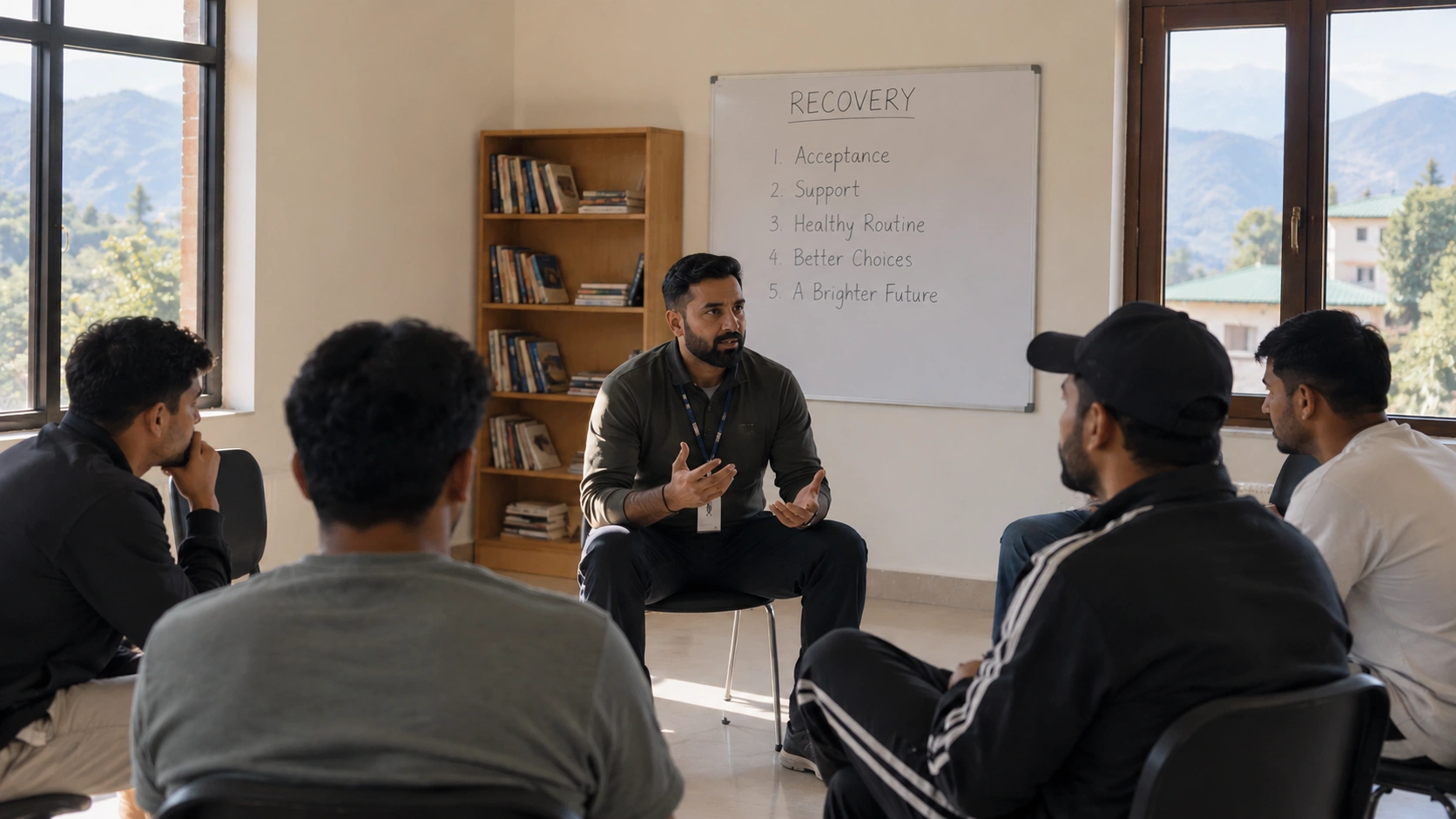
A normal day in a rehab centre runs from about 5.30 in the morning to about 10 at night. It starts with yoga and tea, then breakfast, then assigned duties called work therapy. The middle of the morning is the group meeting, where residents share what happened and what they wrote, followed by a reading from recovery literature that the group discusses. Afternoons are therapy sessions and activities, with individual counselling slotted in. Evenings are sports, a walk, recreation, journal writing and a night discussion, then dinner, medicines and lights out. Doctors review residents regularly and families visit on fixed days.
That is the skeleton of what happens in a rehab centre. Below it is explained block by block, including the parts that sound strange from outside, like why a man who has not cooked in his life is suddenly on kitchen duty.
The Full Day in a Rehab Centre, Hour by Hour
This is what happens in a rehab centre on a normal day, hour by hour. Exact timings vary by about an hour between centres, and Sundays are usually lighter with visiting hours added.
| Time | What happens | What it is for |
|---|---|---|
| 5.30 to 6.00 am | Wake up, fresh up, beds made | A fixed wake time is the first discipline. Sleep has usually been broken for years |
| 6.00 to 7.00 am | Yoga, stretching, exercise, meditation | Settles the body, helps with the restlessness and poor sleep of early recovery |
| 7.00 to 7.30 am | Morning tea, personal hygiene, shaving, laundry | Self-care that had stopped completely for many people |
| 7.30 to 8.30 am | Breakfast | Proper meals at fixed times. Appetite and weight usually recover fast |
| 8.30 to 9.30 am | Work therapy, assigned duties | Kitchen, cleaning, serving, store, garden. Responsibility practised in real life |
| 9.30 to 11.00 am | Morning meeting and sharing | The main group session. What happened yesterday, what he wrote, feedback from peers |
| 11.00 to 12.00 noon | JFT reading and discussion | One daily page of recovery literature read aloud, then unpacked by the group |
| 12.00 to 1.00 pm | Individual counselling, doctor round, medicines | One to one slots, psychiatrist and medical reviews, prescriptions given out |
| 1.00 to 2.00 pm | Lunch | Ghar jaisa khana, eaten together, nobody eats alone |
| 2.00 to 3.30 pm | Rest period | Short rest or quiet reading. The only unstructured block of the day |
| 3.30 to 5.00 pm | Afternoon session or activity | Group therapy, relapse prevention, life skills, a lecture or a structured activity |
| 5.00 to 5.30 pm | Evening tea and snack | Break, informal talking, the hour where friendships actually form |
| 5.30 to 7.00 pm | Sports, walk, time outdoors | Cricket, volleyball, badminton or a walk. Physical tiredness helps night sleep |
| 7.00 to 8.00 pm | Recreation, television, a film, songs | Normal enjoyment without a substance, which many have not had in years |
| 8.00 to 8.45 pm | Journal writing and night sharing | Writing the day down, then saying one honest thing to the group |
| 8.45 to 9.30 pm | Dinner | Last meal, taken together |
| 9.30 to 10.00 pm | Night medicines, final round, prayer | Sleep medication where prescribed, staff check, lights out |
Count the empty hours. There is roughly one and a half hours of unstructured time in sixteen waking hours. That is deliberate. Empty time is where craving, brooding and bad decisions live, and a good centre fills it on purpose.
Morning: Yoga, Tea and Breakfast
The first thing to understand about what happens in a rehab centre is that the day starts early and starts the same way every time, which is the point. Most people arriving at a rehab centre have not had a fixed wake time in years. Sleep had become whatever happened after the last dose or the last peg.
Yoga and exercise at 6 am
Nobody enjoys this in week one, and most people defend it by month two. Early recovery brings restlessness, aches, poor sleep and a body that feels wrong, and movement in the morning takes the edge off all four. It is also the first thing in the day he completes, which matters more than it sounds for a man who has not finished anything in a long time. Our page on yoga for stress and anxiety covers the breathing work that usually goes with it.
Tea, hygiene and breakfast
Then bed tea, shaving, bathing, washing clothes, making the bed. This sounds trivial and it is not. Self-care is one of the first things to collapse in addiction and one of the first signals that someone is coming back. Staff notice a resident who has started shaving again before he says anything in a meeting.
Breakfast is at a fixed time and eaten together. Appetite returns quickly once the substance is out, and weight gain in the first month is normal and welcome. Families visiting at four weeks often say the face looks different, and it usually does.
Work Therapy: Why He Is Washing Dishes
Of everything in what happens in a rehab centre, this is the block families question most. The phone call usually goes: we are paying fees, why is my son cleaning the kitchen? It is a fair question and it has a real answer.
Work therapy means assigned duties: helping prepare lunch or dinner, serving food, cleaning common areas, managing the store, looking after the garden. Duties rotate, and they are given out after the detox period, once a person is physically well enough.
Why this counts as treatment
It comes from the therapeutic community model, where the idea is that the community itself is the method. Treatment is not only what happens in the counselling room. The living environment, the peer group and the shared responsibilities are the treatment too.
What it is actually training
- Turning up to something at a fixed time, every day
- Finishing a task somebody else is depending on
- Taking instruction without an argument
- Being useful, after years of being the problem
- Practical skills, including cooking, that many men genuinely lack
- Tolerating boredom and frustration without a substance
Where to draw the line
- Duties should be shared and rotated, not dumped on the same people
- Nobody in active detox should be on duties
- It should not replace paid staff for the core running of the place
- It should never be used as punishment
- Hours should be modest, roughly an hour a day, not half the day
- You are allowed to ask exactly what the duties are before admission
A centre where residents do a reasonable rotating share is normal and healthy. A centre where residents run the whole establishment while staff watch is something else, and it is worth asking about during a visit.
The Morning Meeting, Which Is Where Most of the Work Happens
If you had to pick one block in what happens in a rehab centre that actually changes people, it is this one. Everyone sits in a circle. It usually runs an hour and a half.
- Each person speaksHow the night was, how he is feeling today, what came up. Nobody is allowed to pass with "theek hai" forever.
- What he wrote is discussedJournals and assignments from the day before are read out or summarised. Writing something privately and then saying it out loud are two different acts, and the second one is the one that works.
- The group respondsThis is the part that does not exist anywhere else in his life. Twenty men who have used the same substances and told the same lies will not accept an excuse that a mother or a wife would let pass.
- Behaviour gets namedSomeone skipping duties, picking fights, hoarding something, isolating. The community raises it rather than only the staff, which lands differently.
- Something small is committed toNot "I will never use again". Something for today, which is the whole philosophy of the reading that follows.
Most residents hate this for the first two weeks and then find it is the thing they miss after discharge. That is also why aftercare and follow-up meetings matter so much once someone goes home.
JFT: The Daily Reading
JFT stands for Just For Today, the daily meditation book used by Narcotics Anonymous. Alcoholics Anonymous groups use an equivalent daily reflection. Most Indian rehab centres run this as a fixed slot, usually late morning.
Each date in the book has one page: a short quote from recovery literature, a reflection of a few paragraphs, and a one-line commitment that begins "Just for today". One person reads the page aloud, and then the group talks about what it means for them, today, in this building.
Why "just for today" and not "forever". Asking someone to promise he will never drink or use again for the rest of his life is asking for something nobody can honestly deliver, and the failure is built in. Twenty-four hours is a promise a person can actually keep, and then keep again tomorrow. For a lot of men this is the first idea in the whole programme that feels possible.
Centres vary in how much religion sits alongside this. Some add a morning prayer or bhajan, some keep it entirely secular. If that matters to your family in either direction, ask before admission. It is a reasonable question and a good centre will answer it straight.
Afternoon: Sessions and Activities
The afternoon half of what happens in a rehab centre begins with a short rest, the only genuinely free block of the day, and then the afternoon session. This is where the structured teaching happens, and it rotates through the week.
- Group therapy on a theme: anger, shame, family, money, triggers, what happened the last time he relapsed
- Relapse prevention, which is practical work on identifying his own high-risk situations and planning for them in advance
- Psychoeducation, a lecture on what the substance did to his brain, liver, sleep and memory, with time for questions
- Life skills, including handling money, finding work, rebuilding trust at home, and what to say to people who ask where he has been
- Step work, where the centre follows the twelve-step model, usually written and then discussed
- Structured activity, art, music, drama or group games, which does more than it looks like it does for men who have not played at anything in years
Our article on the psychology of addiction covers much of the same ground the psychoeducation sessions do, if you want to understand what he is being taught.
Individual Counselling, Which Happens Around the Edges
One to one counselling is not a single slot on the timetable. It is slotted in through the day, usually around midday and in gaps, so that each resident gets regular private time with a counsellor.
This is where the things that cannot be said in a circle of twenty men get said: what happened in childhood, the debt nobody knows about, the marriage, the thing he did while using that he has not told anyone. Group work and individual counselling do different jobs and a centre needs both.
Alongside it, a doctor reviews residents and a psychiatrist reviews medication. During the first weeks that is frequent. Later it settles into a routine review. When you are choosing a centre, ask how many residents there are per counsellor, because that single number decides how much private time anyone actually gets.
Evening: Sports, Recreation and Winding Down
The evening half of what happens in a rehab centre deliberately gets lighter and more physical after tea.
Sports and the walk
Cricket, volleyball, badminton, or a walk in the open. In Himachal that last one is not a small thing, because most centres sit somewhere with hills in view and the walk does real work on mood. Physical tiredness in the evening also helps with the broken sleep that follows people into early recovery for weeks.
Television, films and songs
Then recreation: a film, music, television, carrom, cards. Families sometimes see this on a timetable and wonder what they are paying for. The answer is that a man who has spent five years believing nothing is enjoyable without chitta or sharab has to find out, by direct experience, that an ordinary evening can be alright. There is no lecture that teaches that. He has to sit through a few hundred normal evenings and notice.
Journal Writing and the Night Discussion
Towards the end of the evening, residents write. What happened today, what was difficult, what he felt, what he is grateful for, what he is avoiding. Some centres set a specific assignment, some leave it open.
Then there is a short night sharing or discussion, where people say one honest thing before the day closes. What gets written tonight is often what gets discussed in tomorrow's morning meeting, which is why the writing is taken seriously rather than treated as homework.
After that, dinner, night medicines, a final round by staff, and lights out at about ten. For somebody whose nights were the worst part of his life for years, a boring, early, predictable night is itself a form of treatment.
Week One Is Not Like This At All
Everything above describes what happens in a rehab centre for a settled resident. The first week is different, because detox comes first and the body has to be made safe before anything else is useful.
- Day one: admission and assessmentHistory taken, what he uses and how much, physical examination, blood pressure and pulse, blood tests where needed, psychiatric assessment, consent and paperwork, belongings checked in. He is usually exhausted and frightened.
- Days one to three: the hardest partWithdrawal is managed with prescribed medicines and monitoring. For alcohol, symptoms usually begin within 6 to 24 hours of the last drink and peak between 24 and 72 hours, which is also when the risk of seizures is highest. For heroin or chitta, symptoms typically start within 8 to 12 hours and peak at around 2 to 3 days.
- Days three to seven: coming backOpioid withdrawal is at its worst around day two or three and the acute phase generally settles over 7 to 10 days. Sleep is poor, appetite starts returning, mood swings badly. He will probably ask to go home during this week. Almost everybody does.
- No duties yetNobody in active detox is put on work therapy. He rests, eats, takes medicines, and sits in on sessions only as much as he can manage.
- Joining the routineAs the body settles, he is eased into the full timetable: first the meetings, then the sessions, then duties. By the second or third week most people are on the normal day.
Alcohol withdrawal can cause seizures and a dangerous condition called delirium tremens, which typically appears 48 to 72 hours after the last drink. This is the reason a centre must have a doctor and a link to a hospital, and the reason stopping heavy daily drinking suddenly at home is genuinely risky. Opioid withdrawal is usually not life-threatening but it is severe enough that people leave treatment over it, which is why it is medicated. Our guide to alcohol addiction recovery explains this in more detail.
If you are still at the stage of trying to get someone through the door, we have a separate guide on how to help someone who refuses to go to rehab.
How the Months Change
What happens in a rehab centre stays roughly the same month to month, but a resident's place in it shifts. Most centres run something like this.
| Stage | Roughly when | What is different |
|---|---|---|
| Detox | Week 1 | Medical focus, rest, no duties, partial attendance at sessions |
| Settling in | Weeks 2 to 4 | Full timetable, first duties, learning how the meetings work, still arguing about being there |
| Doing the work | Month 2 to 3 | Deeper counselling, step work, family sessions begin, the honest conversations start |
| Taking responsibility | Month 3 to 5 | Senior duties, helping newer residents, more trust and more freedom |
| Preparing to leave | Final weeks | Relapse prevention plan written, family counselling, work and routine planned for home |
| Aftercare | After discharge | Follow-up calls, review visits, meetings, family support |
The last two rows are where programmes quietly succeed or fail. A centre that discharges someone on day 90 with a handshake and no plan has done half a job.
The Weekly Rhythm
On top of the daily version of what happens in a rehab centre, most centres run a weekly cycle.
- A doctor's round and a psychiatrist review on fixed days
- Family visiting on a set day, usually Sunday, within fixed hours
- Family counselling sessions, which are for the family as much as the resident
- A longer group or guest session, sometimes someone in long-term recovery coming to speak
- A cleaning and inspection day for rooms and common areas
- Sunday generally lighter: a late start, a special meal, films, games
Visiting rules exist for a reason, which is that unlimited visits in early treatment tend to destabilise people and are a common route for things to be smuggled in. A centre that allows no contact at all, though, is a warning sign rather than a strict one. You should be able to see him and speak to him on an agreed schedule from the start.
Luxury Rehab Versus a Normal Rehab Centre
Search what happens in a rehab centre and you will find pages describing private rooms, sound healing, equine therapy, spa treatments and chefs. Those places exist and they cost several lakh a month. It is worth being clear about what is actually different and what is not.
| What | Luxury rehab | Normal rehab centre |
|---|---|---|
| Daily structure | Fixed timetable | Fixed timetable, broadly the same shape |
| Core treatment | Detox, group therapy, counselling, relapse prevention | Detox, group therapy, counselling, relapse prevention |
| Room | Private, hotel standard | Shared, or private at a higher plan |
| Extras | Spa, sound and music healing, equine or art therapy, gym, chef menus | Yoga, sports, films, basic recreation |
| Staff ratio | Higher, more one to one time | Varies a great deal, worth asking the number |
| Work therapy | Usually none | Standard, and arguably useful |
| Typical cost | Several lakh per month | Roughly ₹12,000 to ₹40,000 per month in Himachal |
The honest summary: the thing that treats addiction is the same in both, and it is the structure, the group, the counselling and the aftercare. What more money buys is comfort, privacy and staff time. Comfort is not nothing, especially for someone who will not go otherwise. But a family that borrows against land to buy sound healing has bought the wrong thing. Our breakdown of rehab centre fees in Himachal Pradesh sets out what each level actually costs here.
Why the Routine Itself Is the Treatment
People read what happens in a rehab centre, see the timetable, and assume the therapy sessions are the treatment while the rest is filler. It is closer to the opposite.
It replaces a life built around one thing
For years the day was organised around getting, using and recovering from a substance. Removing that leaves a hole. A fixed day fills it with something else before craving does.
It removes a thousand small decisions
Deciding what to do with an empty afternoon is exactly the decision that goes wrong in early recovery. For the first months, the timetable decides, and that is a relief more than a restriction.
It rebuilds sleep, appetite and body
Fixed waking, exercise, three proper meals and a 10 pm lights out repair things that medication alone does not fix.
It is practice, not instruction
Being told to be reliable changes nothing. Turning up to duty at 8.30 every morning for four months is the actual training, and it transfers home.
The group is the mirror
Twenty people who know every excuse because they have used every excuse. No family member can provide that.
It is something to take home
The residents who hold on after discharge are usually the ones who kept some version of the routine: the early start, the walk, the writing, the meeting.
Rules, Phones and What He Can Take With Him
Beyond what happens in a rehab centre hour by hour, every centre has house rules, and they are reasonable questions to ask about before admission rather than discovering afterwards.
| Question | What is usual |
|---|---|
| Mobile phones | Usually restricted, especially early on, with supervised calls home on fixed days. Ask what the schedule is |
| Visits | Fixed visiting day and hours, often Sunday. Should never be zero |
| What to bring | Clothes, slippers, toiletries, prescribed medicines with prescriptions, a few photographs. No cash, no valuables |
| Smoking and tobacco | Policies differ widely. Some allow limited smoking, some are fully tobacco free. Ask |
| Food from home | Usually checked, sometimes limited on visiting days |
| Can he leave | For a voluntary admission, yes, with process. Admission without consent is strictly limited by law |
| Punishment | There should be none of the physical kind. Chains, beating and locked rooms are abuse, not discipline |
A centre in Himachal must be registered with the State Mental Health Authority. The state has ordered penalties of up to ₹5 lakh for running one without registering, and unregistered centres are behind most of the serious stories. Our guide to the best rehabilitation centre in Himachal Pradesh lists what to check on a visit, and we explain the difference between a rehab centre and a nasha mukti kendra separately.
नशा मुक्ति केंद्र में दिन भर क्या होता है
अगर आप सोच रहे हैं कि रिहैब सेंटर में पूरा दिन क्या होता है, तो दिनचर्या कुछ ऐसी रहती है।
- सुबह 5:30 से 6 बजे उठना, फिर योग, व्यायाम और ध्यान।
- चाय, नहाना-धोना, अपने कपड़े खुद धोना, फिर नाश्ता।
- वर्क थेरेपी, यानी अपनी-अपनी ड्यूटी: रसोई में मदद, सफाई, खाना परोसना। ये सज़ा नहीं, इलाज का हिस्सा है।
- सुबह की मीटिंग, जिसमें हर कोई अपनी बात रखता है और जो लिखा था वो सबके सामने पढ़ा जाता है।
- JFT यानी Just For Today का पाठ, जिसमें रोज़ एक पन्ना पढ़कर उस पर चर्चा होती है।
- दोपहर का खाना, थोड़ा आराम, फिर दोपहर का सेशन या ग्रुप थेरेपी।
- शाम की चाय, फिर खेल, सैर, क्रिकेट या वॉलीबॉल।
- टीवी, फिल्म, गाने, फिर डायरी लिखना और रात की चर्चा।
- रात का खाना, दवाइयाँ, और करीब 10 बजे लाइट बंद।
- बीच-बीच में अकेले में काउंसलिंग और डॉक्टर का राउंड भी चलता रहता है।
पहला हफ्ता अलग होता है। उसमें डिटॉक्स होता है, दवाइयों के साथ, और ड्यूटी नहीं दी जाती। शरीर ठीक होने पर ही पूरी दिनचर्या शुरू होती है। और पढ़ें: चिट्टा कैसे छोड़ें।
What a Day Looks Like at Eshan Charitable Trust

Eshan Pathania, Founder and Managing Trustee
Why we publish the timetable
Eshan Pathania, our founder and managing trustee, has been in recovery himself for five years, which means he has lived this day rather than designed it from a desk.
Most centres will not tell a family what the day actually contains. We would rather you read it, ask awkward questions about it, and come and watch a normal morning before you admit anybody. A centre that will not let you see an ordinary day is telling you something.
Our day follows the shape set out above: yoga at 6 am, breakfast, work therapy, the morning meeting, the daily reading, lunch, an afternoon session, evening sports and a walk, recreation, journal writing and night sharing, dinner, medicines and lights out. Individual counselling runs through the day and the psychiatrist reviews residents regularly. The programme runs for 180 days in eight stages, starting with medically supervised detox.
Our fees, stated plainly
| Plan | Room and diet | Fee |
|---|---|---|
| Shared Residential Care | Shared room, standard diet | ₹12,500 per month |
| B Caring | Deluxe room, twin sharing, upgraded diet | ₹25,000 per month |
| A Caring | Private room, single occupancy, upgraded diet | ₹40,000 per month |
| Medically supervised detox | Once, at admission | ₹6,000 one time |
Every plan gets the same treatment, the same timetable and the same counselling. Only the room and the diet change. Accommodation and meals, prescribed medicines, doctor and psychiatrist reviews, counselling, group therapy, yoga, fitness, all activities and family counselling are included. If ₹12,500 is out of reach, call and say so honestly, because we reduce fees where we genuinely can.
What families can verify
- HP State Mental Health Authority, Shimla: Provisional Registration Sr. No. 193, under Sections 66(4) and 66(11) of the Mental Healthcare Act 2017, issued 14/05/2026. The certificate can be inspected at the centre.
- Registered charitable trust: Regd. No. 2025/19/IV/123.
- Residential care for men aged 18 and above, with no upper age limit.
- No beating, no chains, no locked rooms and no forced pick-up. Families are encouraged to visit.
- Close to Dr Rajendra Prasad Government Medical College, Tanda, with families coming from Kangra, Hamirpur, Bilaspur, Mandi, Chamba and Una.
Get directions to our centre in Tanda Kholi, Kangra.
Questions Families Ask About What Happens in a Rehab Centre
What happens in a rehab centre every day?
What happens in a rehab centre is a fixed timetable running from about 5.30 am to about 10 pm. Yoga and meditation, tea, breakfast, assigned duties called work therapy, the morning group meeting, a daily reading from recovery literature, lunch, a short rest, an afternoon therapy session or activity, evening tea, sports or a walk, recreation such as a film or songs, journal writing and a night discussion, dinner, medicines and lights out. Individual counselling and doctor reviews run through the day.
What is the daily routine in a nasha mukti kendra?
It is broadly what happens in a rehab centre anywhere in India. Early wake up, yoga, breakfast, duties, a group meeting, the Just For Today reading, lunch, afternoon session, evening sports, recreation, journal writing, dinner, medicines and a 10 pm lights out. Timings move by about an hour between centres, and Sunday is usually lighter with family visiting hours.
How do I find a good nasha mukti kendra near me?
When people search for a nasha mukti kendra near me, the first result is not always the right one. Ask three things of any centre on the list: is it registered with the State Mental Health Authority and can you see the certificate, who is the psychiatrist and how often does he visit, and how long is the programme. Then visit and watch an ordinary morning. Distance matters less than those three answers, and a little distance from his old friends and routes often helps. Searching rehab near me in India mostly returns physiotherapy clinics, so use nasha mukti kendra or de addiction centre with your town name instead.
How do I choose a nasha mukti kendra near me in Himachal?
Searching nasha mukti kendra near me will give you both government and private options. Government psychiatry departments, Red Cross centres and IRCA centres are free or nominal. Private and trust run centres charge a fee and must hold the same registration. Ask for the registration number, the daily timetable in writing, the counsellor to resident ratio and the visiting policy, then compare. Our district pages cover Kangra, Dharamshala, Palampur, Nurpur, Baijnath, Chamba, Mandi, Bilaspur and Hamirpur.
Is a de addiction centre near me the same as a nasha mukti kendra near me?
In everyday use yes, and the daily routine described here is followed at both. De-addiction centre tends to emphasise the medical detox part and rehabilitation centre the longer months of therapy afterwards, but no law reserves either name, and most centres use both words. Under the Mental Healthcare Act 2017 they are the same legal category, a mental health establishment, and both must be registered.
What is work therapy in rehab and why does my son have to do it?
Work therapy means assigned rotating duties such as helping in the kitchen, serving food, cleaning common areas or looking after the store. It comes from the therapeutic community model, where the shared living environment is treated as part of the treatment rather than just housekeeping. It trains turning up on time, finishing a task others depend on, taking instruction and being useful again. Duties are given only after detox, should be modest and rotated, and should never be used as punishment.
What is JFT in rehab?
JFT stands for Just For Today, the daily meditation book used by Narcotics Anonymous, with one page for each date containing a quote, a short reflection and a one-line commitment. In most Indian rehab centres one person reads the day's page aloud and the group then discusses what it means for them. The twenty-four hour frame matters, because promising never to use again for a whole lifetime is a promise nobody can keep, while today is one a person actually can.
What happens in the first week of rehab?
The first week is detox and it does not look like the normal timetable. Day one is assessment, examination, tests and paperwork. Alcohol withdrawal usually begins within 6 to 24 hours of the last drink and peaks between 24 and 72 hours, which is also the highest risk period for seizures. Opioid withdrawal from heroin or chitta usually starts within 8 to 12 hours and peaks at around 2 to 3 days, with the acute phase settling over 7 to 10 days. No duties are given during detox and he joins the full routine as his body allows.
Will he be allowed his mobile phone?
Usually not freely, especially in the early weeks, with supervised calls home on fixed days instead. This is partly to protect early recovery and partly because phones are a common route for supply and for old contacts. Ask any centre what its calling schedule is before admission, and treat a centre that allows no contact at all as a warning sign rather than a strict one.
Can we visit, and how often?
Most centres have a fixed visiting day, often Sunday, within set hours, plus scheduled family counselling sessions. Unlimited visiting in early treatment tends to unsettle people, so some structure is normal. No visiting at all is not normal and you should not accept it.
Is there a doctor present every day?
Arrangements vary. Registered centres in Himachal must have a medical officer or psychiatrist available and a link to a hospital for emergencies, with nursing cover. Ask specifically who sees residents daily, how often the psychiatrist visits, and who is reachable at two in the morning. That last question is the useful one.
How long does someone usually stay?
Detox is roughly one to two weeks. Rehabilitation is measured in months rather than weeks, because habits, friendships and triggers built over years do not change in a fortnight. Government residential stays are often around a month, while longer private and trust programmes run for three to six months. The programme at Eshan Charitable Trust runs for 180 days in eight stages.
What is the difference between luxury rehab and a normal rehab centre?
The core treatment is the same: medically supervised detox, group therapy, individual counselling, relapse prevention and aftercare, all run on a fixed daily structure. What extra money buys is comfort, privacy and staff time, plus extras such as spa facilities, sound or music healing, equine therapy and chef menus. Luxury centres typically cost several lakh a month against roughly twelve thousand to forty thousand rupees a month in Himachal, and work therapy is usually absent at the luxury end.
Does he just sit around all day?
No. There is roughly one and a half hours of unstructured time in a sixteen hour waking day, and that is deliberate. Empty time is where craving and brooding do their damage, so a good centre fills it with meetings, sessions, duties, sports and recreation.
Is the day the same on Sundays?
Usually lighter. A later start, a special meal, films or games, and the family visiting slot. Many centres also use Sunday for a longer group session or a talk by someone in long-term recovery.
What should he bring with him?
Clothes for the weather, slippers, toiletries, any prescribed medicines with their prescriptions, and a few photographs. No cash, no valuables, no electronics beyond what the centre allows. Ask for the centre's own list, because it varies, and expect belongings to be checked at admission.
Are the groups and meetings compulsory?
Yes, attendance is expected, because the group work is the core of the programme rather than an optional extra. What is not compulsory is how much a person shares on any given day. Most residents say very little for the first two weeks, and that is both normal and tolerated.
Is religion part of the daily routine?
It depends entirely on the centre. Some include a morning prayer, bhajan or satsang slot, some keep the day completely secular and use only recovery literature. If this matters to your family in either direction, ask before admission rather than after.
रिहैब सेंटर में पूरा दिन क्या होता है?
सुबह 5:30 से 6 बजे उठना, योग और ध्यान, चाय, नाश्ता, फिर वर्क थेरेपी यानी अपनी ड्यूटी। उसके बाद सुबह की ग्रुप मीटिंग और JFT का पाठ। दोपहर का खाना, थोड़ा आराम, फिर दोपहर का सेशन। शाम को चाय, खेल और सैर, फिर टीवी या फिल्म, डायरी लिखना और रात की चर्चा। आखिर में रात का खाना, दवाइयाँ और करीब 10 बजे लाइट बंद। बीच-बीच में अकेले में काउंसलिंग और डॉक्टर का राउंड चलता रहता है। पहले हफ्ते में डिटॉक्स होता है और ड्यूटी नहीं दी जाती।
What is the nasha mukti kendra number to call?
For free national help, the de-addiction helpline number is 14446 and Tele MANAS is 14416, both toll free and available in your own language. For an ambulance in an emergency, call 108. Our own number at Eshan Charitable Trust is +91 62304 15581, answered 24x7 on call and WhatsApp, and you are welcome to ring it about someone who has not agreed to treatment yet. Before calling any private centre, ask for its registration number under the Mental Healthcare Act 2017 and check it with the state mental health authority.
Can we see a normal day before we admit him?
You should be able to, and we would encourage it. Ask to visit on a working weekday rather than a Sunday, so you see the actual routine rather than the lighter version. Look at the rooms, the kitchen, the toilets and the notice board with the timetable on it, and ask to meet the counsellor who would be working with him. A centre that makes excuses about an ordinary visit is telling you something useful.
A Last Word for the Family
So when you picture what happens in a rehab centre, picture an ordinary, slightly boring, very full day. Men getting up early, doing yoga badly, eating together, washing up, sitting in a circle and saying difficult things out loud, playing cricket in the evening, writing a page before bed and sleeping at ten. That is what happens in a rehab centre, and it is not dramatic at all. The lack of drama is rather the point.
If a centre cannot tell you what its day contains, or will not let you come and watch one, that is the answer to your question. Ask for the timetable, ask for the registration, ask who the psychiatrist is, and go and look.
And if you are still at the earlier stage, where he has not agreed to any of this yet, that is a different and very common problem, and we have written about it separately.
Sources and References
The withdrawal timelines, the therapeutic community model and the recovery literature described here come from the sources below. The daily timetable reflects the routine followed at our own centre and at comparable centres across India.
- Cleveland Clinic. Alcohol withdrawal, symptoms, treatment and timeline.
- GoodRx. Opioid withdrawal, typical timeline and common symptoms.
- Recovery.com. Therapeutic communities, community as method and the role of resident responsibilities.
- Australasian Therapeutic Communities Association. Therapeutic community model of treatment.
- Narcotics Anonymous World Services. Just For Today, daily meditations for recovering addicts.
- Government of India. The Mental Healthcare Act, 2017, India Code.
- Himachal Pradesh State Mental Health Authority. Register of private mental health establishments.
- The Tribune. Standards prescribed for registered rehabilitation centres in Himachal Pradesh.
- The Tribune. Unregistered rehab centres to be penalised.
- World Health Organization. Opioid overdose, fact sheet.
- Ministry of Health and Family Welfare. Tele MANAS, National Tele Mental Health Programme.
- Ministry of Social Justice and Empowerment. Nasha Mukt Bharat Abhiyaan.

Dr. Devasheesh Sharma, MBBS, DNB (Psychiatry)
Psychiatrist. Himachal Pradesh Medical Council Reg. No. 5263.
Dr. Aditya Thakur, MBBS
Registered medical practitioner. Himachal Pradesh Medical Council Reg. No. 6218.
Eshan Charitable Trust Team
The counsellors and staff at our nasha mukti kendra in Kangra, who run this timetable every day. Last reviewed on 4 October 2026. More answers are on our frequently asked questions page.
This guide is for information and support. It does not replace a consultation with a doctor or psychiatrist who can examine the person you are worried about.