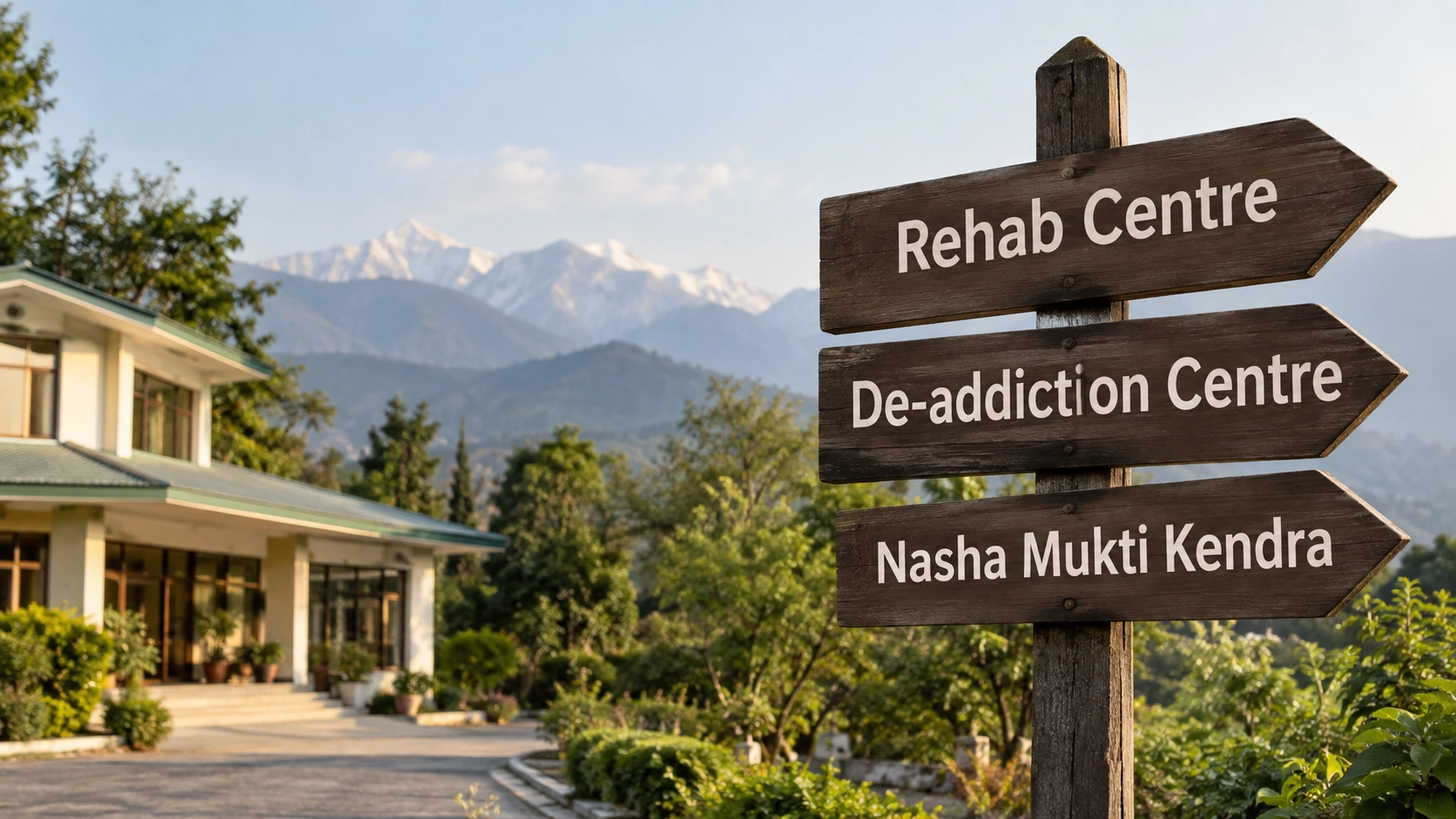
A father from Palampur rang us with a question we hear almost every week. One board says rehabilitation centre, the next says drug de-addiction centre, the third says nasha mukti kendra, and a fourth says something with four capital letters in it. Which one does my son need? The honest answer is that these words mostly describe the same thing, and the difference that will actually change his life is written somewhere else entirely.
So this guide does two jobs. First, it explains the difference between rehab centre and nasha mukti kendra properly, along with de-addiction centre and the government scheme names you will see on signboards in Himachal. Second, and more usefully, it shows you what to look at instead, because the word on the board is one of the weakest signals of quality you can rely on.
This page is published by Eshan Charitable Trust, a registered nasha mukti kendra in Kangra. We are a private charitable trust, so we have included ourselves where it is relevant and said so plainly. Everything here is based on publicly available information, government scheme documents and our team's own enquiries. Details change, so please confirm anything important before you admit anyone anywhere.
- In everyday Indian use, the three words mean the same thing. Rehab centre, de-addiction centre and nasha mukti kendra are all used for places that treat alcohol and drug dependence. No law reserves one name for one kind of place.
- Where a difference does exist, it is about length. De-addiction usually points at the short medical part, detox. Rehabilitation usually points at the longer months of counselling and routine afterwards. Many centres do both and use both words.
- The law has one name for all of them: a mental health establishment under the Mental Healthcare Act, 2017. Every one of them, government or private, must register with the State Mental Health Authority.
- Scheme names like IRCA, DDAC, ODIC, ATF and OST describe funding and function, not quality. They tell you who pays and what the place is meant to do, nothing more.
- Ask about the registration, the psychiatrist and the length of the programme. Those three answers tell you more than any signboard. If you need a starting point today, call 14446 or 14416, both free.
The Short Answer: Three Names, One Kind of Place
If someone gave you sixty seconds on the difference between rehab centre and nasha mukti kendra, here is what you would need to know.
Nasha mukti kendra is simply the Hindi name. Nasha means intoxicant, mukti means freedom, kendra means centre. De-addiction centre is the English phrase Indian government programmes have used since the 1980s, and it leans towards the medical side: withdrawal, medicines, stabilising the body. Rehab centre, short for rehabilitation centre, leans towards the longer part: therapy, routine, skills, going back to normal life. In practice almost every centre in Himachal uses two or three of these words on the same board, and that is not dishonest. It is just how the vocabulary grew.
So when a family asks us whether they should look for a rehab centre or a nasha mukti kendra, the real question underneath is usually one of these: how long will he stay, who is the doctor, is this place legal, and what will it cost. Those four have clear answers. The name does not.
What Each of the Three Names Actually Means
Let us take them one at a time, because each word does carry a slight flavour even if none of them is a legal category.
Rehab centre, or rehabilitation centre
Rehabilitation means rebuilding a life, not just cleaning out a body. A place that calls itself a rehabilitation centre is usually signalling a longer residential stay, structured therapy, group work, daily routine, sometimes vocational training, and a plan for going home. It is also the broadest word of the three. In India, rehabilitation centre is used for addiction, for long term psychiatric care, and sometimes for physiotherapy and disability rehabilitation, which has nothing to do with nasha at all. If you search the phrase on its own, you will get all three mixed together.
De-addiction centre
This is the phrase the Indian government has used the longest. The Ministry of Health and Family Welfare has run a Drug De-Addiction Programme since the late 1980s, and under it, de-addiction centres were set up inside district hospitals and medical college psychiatry departments with a one time central grant, with states carrying the running costs afterwards. Because of that history, de-addiction centre most often means the medical end of the work: assessment, withdrawal management, medicines, treating the liver or the chest problems that came with years of use.
That said, plenty of long stay private centres call themselves de-addiction centres too. The Red Cross centre at Nurpur in Kangra district is registered as a de-addiction and rehabilitation centre, with both words in the name, which tells you how blurred the line is in practice.
Nasha mukti kendra
This is the name most Himachali families actually use when they talk to each other. It carries no legal meaning on its own, and it is used for everything from a government funded centre to a two room place with no doctor. Because it is the search term families type, it is also the phrase that unregistered centres put on their boards and their websites. That is worth remembering: the more familiar and reassuring the name sounds, the less it tells you.
Anybody can paint any of these three words on a board. None of them requires permission. The thing that requires permission, and that can be checked, is the registration certificate. Ask for it every single time, at a government centre and at a private one.
The Name the Law Actually Uses: Mental Health Establishment
Here is the part that most families have never been told, and it is the single most useful thing on this page about the difference between rehab centre and nasha mukti kendra.
Under the Mental Healthcare Act, 2017, mental conditions connected with the abuse of alcohol and drugs are included inside the definition of mental illness. The Act then defines a mental health establishment very widely: any health establishment, by whatever name called, wholly or partly meant for the care of persons with mental illness, run by government, a trust, a society, a company or anyone else, where such persons are admitted and reside.
Read those two together and the conclusion is simple. A rehab centre, a de-addiction centre and a nasha mukti kendra are all, in law, the same category of thing: a mental health establishment. Section 65 of the Act then says no person or organisation may run one unless it is registered with the State Mental Health Authority, and that the Authority sets the minimum standards. Writing in the Indian Journal of Psychiatry, psychiatrists made the same point: once addiction counts as mental illness, every de-addiction or rehabilitation centre admitting such patients has to be registered under the Act and is open to inspection.
Himachal said this out loud years ago. When the state made registration compulsory, the Additional Chief Secretary (Health) told The Tribune that alcohol and drug abuse came under mental illness, that de-addiction centres were therefore mental health establishments, and that their treatment and rehabilitative services would be regulated by the State Mental Health Authority.
What this means for you in practical terms. You do not need to work out whether a place is "really" a rehab or "really" a nasha mukti kendra. You need to ask one question: are you registered with the Himachal Pradesh State Mental Health Authority, and can I see the certificate? A centre that cannot answer that has failed, whatever is written on its gate.
The Real Types of Addiction Centre in India, and What Each One Does
Now we can get to the differences that are genuinely real. The difference between rehab centre and nasha mukti kendra is mostly about words, but these are not different names for the same thing. They are different kinds of service, with different funding, different staff and different jobs.
1. Hospital psychiatry department
The psychiatry department of a medical college or district hospital. Qualified psychiatrists, medicines from the essential drug list free of cost, lab tests, and a full hospital on the same campus. Handles detox, treats depression or anxiety alongside addiction, and refers onward. The strongest medical option in most districts, with the fewest residential beds.
2. De-addiction centre inside a government hospital
Set up under the Drug De-Addiction Programme of the Ministry of Health and Family Welfare, usually with a one time central grant and state funding afterwards. Attached to a hospital rather than standing alone. Mostly inpatient detox and outpatient follow-up.
3. Addiction Treatment Facility, or ATF
A newer model, funded fully by the Ministry of Social Justice and Empowerment and coordinated nationally by the National Drug Dependence Treatment Centre at AIIMS. Set up inside existing government hospitals. Outpatient treatment is the essential part of an ATF, with inpatient beds as an add-on at some sites only.
4. OST centre
An Opioid Substitution Therapy centre, run under the National AIDS Control Organisation inside a government hospital, with a doctor, nurse, counsellor and data manager. People dependent on opioids take a long acting medicine daily under supervision, free of cost. It is a long term treatment, not a short course, and it is not a residential nasha mukti kendra.
5. Integrated Rehabilitation Centre for Addicts, or IRCA
The classic government funded residential centre, usually run by an NGO, a trust or a Red Cross society with a grant from the Ministry of Social Justice and Empowerment. Under the scheme, in-patient treatment, stay and food are free of cost. This is the true sarkari nasha mukti kendra most families mean.
6. ODIC and CPLI
An Outreach and Drop In Centre offers screening, assessment, counselling, first aid and referral during the day, with no admission. A Community based Peer Led Intervention works with youth volunteers on early prevention. Both are free and neither is a place you can admit anyone to.
7. District De-Addiction Centre, or DDAC
The current model from the same ministry: a one stop district centre that brings an IRCA, an ODIC and a CPLI together under one roof, so prevention, drop in services and residential treatment sit in one place. Free of cost. Where all three already existed in a district, they are being shifted into the DDAC building.
8. Registered private or trust run centre
An independent residential centre that charges a fee and must hold HPSMHA registration. Some are commercial, some are charitable trusts like ours. This is where most of the long programmes of three to six months sit, and also where quality varies the most.
9. Halfway home
A supported place to live after the main programme, for someone who is stable but not ready to go straight back to the old street and the old friends. Fewer rules than a treatment centre, more structure than home. Rare in Himachal at the moment.
10. Unregistered centre
Running without registration. These are behind most of the horror stories: no psychiatrist, locked rooms, force. They are not a budget version of the others. They are illegal, and in Himachal running one can attract a penalty of up to ₹5 lakh.
Notice what is going on here. Numbers one to seven are all government or government funded, and between them they carry four completely different names for places that a family would describe, perfectly reasonably, as "the sarkari nasha mukti kendra". Our separate list of every government nasha mukti kendra in Himachal Pradesh sets out which district has which.
Detox Versus Rehabilitation: The Difference That Actually Changes Lives
If you are going to care about one distinction in this whole article, make it this one. It is the real difference between rehab centre and nasha mukti kendra, hiding inside the words themselves, and it is the one that decides whether your son is still clean next Diwali.
Detox, roughly 7 to 14 days
- Clears the substance from the body safely
- Manages withdrawal with proper medicines
- Must be medically supervised, especially for alcohol
- Treats immediate problems: dehydration, infection, pain
- Ends with a person who is physically stable
- Does nothing at all about why he started
Rehabilitation, months not weeks
- One to one counselling and group therapy
- Identifying triggers, and practising what to do instead
- A fixed daily routine: sleep, food, exercise, work
- Family counselling, because the home has to change too
- Relapse prevention planning before discharge
- Follow-up after he goes home
A great many relapses in Himachal happen for one reason: the family did detox and called it treatment. Fifteen days in a centre, he comes home looking healthy, everybody is relieved, and within two months he is back with the same friends on the same path. That is not a failure of willpower. It is a treatment that stopped halfway. Our article on the psychology of addiction goes into why the second half matters so much.
Regulators recognise this split. When Delhi wrote its minimum standards under the Mental Healthcare Act, it did not classify centres by their names at all. It classified them by duration and function: short term treatment including detoxification for under one month, long term treatment and rehabilitation for one month or more, and a separate category for people who have a substance problem and another psychiatric illness together. Himachal issued its own minimum standards for subcategories of substance use treatment and rehabilitation facilities in 2022.
Stopping heavy daily drinking suddenly can cause seizures and a dangerous state called delirium tremens. It needs medical supervision. The same goes for high dose benzodiazepine tablets. If someone at home is shaking, sweating, confused or seeing things after stopping sharab, treat it as a medical emergency and call 108. More on this in our guide to alcohol addiction recovery.
Rehab Centre vs De-Addiction Centre vs Nasha Mukti Kendra: The Comparison Table
Here is the difference between rehab centre and nasha mukti kendra set out side by side, with de-addiction centre in the middle column. Use it as a checklist when you phone any centre, whatever it calls itself.
| What you are comparing | De-addiction centre | Rehabilitation centre | Nasha mukti kendra |
|---|---|---|---|
| Language of the name | English, government usage since the 1980s | English, broader usage | Hindi, everyday usage |
| What it usually emphasises | Medical detox and withdrawal | The months of therapy after detox | Anything, the whole range |
| Typical stay implied | About 1 to 4 weeks | 1 to 6 months | Not implied at all |
| Who usually runs one | Government hospitals, trusts, private centres | Trusts, NGOs, private centres, some government | Everyone, including unregistered places |
| Also used for non-addiction care | Rarely | Yes, psychiatric and physical rehabilitation too | No |
| Legal status of the name | No legal definition | No legal definition | No legal definition |
| Registration needed | Yes, with the state mental health authority | Yes, with the state mental health authority | Yes, with the state mental health authority |
| What the name tells you about quality | Nothing | Nothing | Nothing |
| What you should ask instead | Registration number, name of the psychiatrist, length of programme, fees in writing, visiting policy | ||
How India Ended Up With So Many Names for One Thing
None of this confusion was planned. The difference between rehab centre and nasha mukti kendra exists because it built up over forty years, as different ministries, different schemes and different laws each added their own vocabulary. Here is the short version, with dates.
- 1985The Narcotic Drugs and Psychotropic Substances Act is passed, and the idea of treatment for users enters Indian law alongside enforcement.
- Late 1980sThe Ministry of Health and Family Welfare starts the Drug De-Addiction Programme, giving one time grants to set up de-addiction centres in district hospitals and medical college psychiatry departments. The centre at AIIMS New Delhi becomes the National Drug Dependence Treatment Centre. This is where the phrase "de-addiction centre" comes from.
- 1988 onwardsThe Ministry of Social Justice and Empowerment begins funding NGO run residential centres. These later become Integrated Rehabilitation Centres for Addicts, which is where the word "rehabilitation" enters the government vocabulary.
- 29 May 2018The Mental Healthcare Act, 2017 comes into force, replacing the Mental Health Act, 1987. Addiction is inside the definition of mental illness, and every centre that admits such patients becomes a mental health establishment that must register.
- 2018Delhi becomes one of the first states to write minimum standards classifying these facilities by duration and function rather than by name.
- 2020The Nasha Mukt Bharat Abhiyaan is launched in 272 identified vulnerable districts, and the Hindi phrase becomes official government language too.
- 2022Himachal Pradesh issues its own minimum standards for subcategories of substance use disorder treatment and rehabilitation facilities. In the same year, the state's first Addiction Treatment Facility opens at Kullu Regional Hospital in Bhuntar, in collaboration with NDDTC AIIMS, inside what is also called the Integrated Drug Prevention and Rehabilitation Centre, as reported by The Tribune.
- 2025 and 2026The Ministry of Social Justice and Empowerment invites proposals to set up District De-Addiction Centres in gap districts across the country, folding IRCA, ODIC and CPLI services into one building, through the e-Anudaan portal.
So the Bhuntar centre in Kullu is simultaneously an Integrated Drug Prevention and Rehabilitation Centre, an Addiction Treatment Facility and, to every family in the valley, the sarkari nasha mukti kendra. All three descriptions are correct. That is the whole problem in one building.
What These Names Look Like on the Ground in Himachal
Numbers help, so here are the ones on the public record behind the difference between rehab centre and nasha mukti kendra in this state.
different central scheme names for government funded addiction services: IRCA, ODIC, CPLI and DDAC, all under one ministry. Source: MoSJE NAPDDR portal
private de-addiction and rehabilitation centres functioning in Himachal when the state mental health authority last shared a count, in September 2021. Source: The Tribune
square feet of space per person that a registered centre in Himachal must provide, along with sports, yoga and meditation facilities, qualified staff and a medical officer or psychiatrist on call. Source: The Tribune
maximum penalty ordered for running a de-addiction centre in Himachal without registering it with the HPSMHA. Source: The Tribune
Three real examples from the state register
The clearest proof that the name means nothing is the state mental health authority's own register. Look at how differently the entries are named, even though every one of them is the same legal category.
| As listed on the register | What it calls itself | Beds listed |
|---|---|---|
| IRCA Nurpur, near Civil Hospital, Chaugan, Nurpur, Kangra | A de-addiction and rehabilitation centre, funded as an IRCA, registered as a mental health establishment | 15 |
| Akal De-addiction cum Psychiatric Centre, Baru Sahib, Sirmaur | A de-addiction centre and a psychiatric centre in the same name | 50 |
| Eshan Charitable Trust, Tanda Kholi, Kangra | A drug de-addiction and rehabilitation centre, run by a charitable trust | Provisional Registration Sr. No. 193 |
And on the government hospital side
Himachal's own mental health authority records one state mental hospital with 62 beds, a 30 bed psychiatry ward at IGMC Shimla and a 10 bed ward at Dr RPGMC Tanda, with psychiatric and de-addiction services also available at district hospitals where a psychiatrist is posted. At Tanda, the psychiatry department runs mental health services round the clock and holds a special drug de-addiction clinic every Tuesday.
None of those are called nasha mukti kendras. All of them treat nasha. If you live in the valley, our pages for the rehab centre in Dharamshala, the rehab centre in Palampur, the rehab centre in Nurpur and the rehab centre in Baijnath list the nearest options for each area, and there are separate pages for Chamba and Mandi.
Nine Questions That Matter More Than the Name on the Board
Print these, or save them in your phone. They matter far more than the difference between rehab centre and nasha mukti kendra. Ask every one of them, at a government centre and at a private one. A good centre will not mind a single question on this list.
- Are you registered, and may I see the certificate?Ask for the Himachal Pradesh State Mental Health Authority registration, note the number, and confirm it with the authority in Shimla. A genuine centre shows it without hesitation.
- Who is the psychiatrist, and how often does he actually visit?Ask for a name and a medical council registration number, not "we have a doctor". Ask how often he sees each resident, and who is reachable at 2 am.
- Is the detox medically supervised, and is it charged separately?Withdrawal from opioids, alcohol and tablets needs medicines and monitoring. Ask what happens on day one, day three and day seven, and whether detox is inside the monthly fee or billed on top.
- How long is the programme, and what happens in month three?Anyone can describe week one. Ask them to describe month three. If they cannot, there is no programme, only a stay.
- What does a normal day look like, hour by hour?Wake up, yoga, breakfast, group, counselling, lunch, activity, evening session, lights out. A real centre answers this in thirty seconds.
- How many residents per counsellor?This single number tells you how much one to one time anyone actually gets.
- Can we visit before admitting him, see the rooms and meet the counsellor?The most revealing question on the list. A centre that welcomes it is usually fine. A centre that makes excuses is telling you something.
- Will you give me the fees in writing, including what is not included?Medicines, hospital referral, transport, refund if he leaves on day twelve. Get it on paper before admission, never after.
- What is the aftercare, and does it cost extra?Follow-up calls, review visits, a written relapse prevention plan for the family. Ask who makes the call and how often.
Our longer guide to choosing the best rehabilitation centre in Himachal Pradesh goes through what to look at during an actual visit, and our breakdown of rehab centre fees in Himachal Pradesh covers the money side centre by centre.
Red Flags on Any Board, Whatever It Says
The difference between rehab centre and nasha mukti kendra stops mattering here. These apply equally to a place calling itself a rehab centre, a de-addiction centre or a nasha mukti kendra. Any one of them is a reason to walk away.
- Refusing to show a registration certificate, or saying it is "being processed" for months
- No psychiatrist or doctor named anywhere, only "trained staff"
- A pickup service that offers to collect a grown man against his will
- Promises of a 100 per cent cure, or a quoted success rate with no source
- Families never allowed to visit, call or speak to the counsellor
- Cash only, no receipts, fees that change after admission
- Chains, locked rooms, bars, or any sign that people are being beaten
- Detox described as "we just keep him till the craving passes", with no medicines
This is not theoretical in Himachal. In 2021 the state mental health authority reported that fourteen private centres had shut in eighteen months, and its chief executive said inhuman behaviour, threats and physical force had been reported at some centres in the name of rehabilitation. A Tribune investigation in Kangra found centres running without proper licences or psychiatrists. We are a private centre ourselves and we would still rather you were suspicious of us than trusting of the wrong place.
Under the Mental Healthcare Act, 2017, admission is normally voluntary. Admission without consent is allowed only in limited situations, after assessment by qualified mental health professionals and with legal safeguards. Tying someone up or dragging him into a vehicle is not a treatment method, and it can be a crime. If a centre offers this as a service, that is the clearest signal you will ever get.
Which Type of Centre Does Your Family Actually Need?
Forget the difference between rehab centre and nasha mukti kendra for a moment. Here is the practical version, based on the situations families actually describe to us on the phone.
| Your situation | What you actually need |
|---|---|
| He is shaking, vomiting, confused or having fits after stopping | A hospital, today. Not any kind of kendra. Call 108 or go to the nearest emergency department |
| You have no money at all | Government psychiatry OPD, a Red Cross or IRCA centre, and the free helpline 14446. Treatment at government establishments is free or nominal |
| He is using chitta or injecting, and wants to stop | A medically supervised detox first, then a long residential programme. Ask about opioid substitution treatment at a government hospital as well |
| He has stopped before and relapsed within weeks | Longer rehabilitation, not another detox. Three to six months with real counselling and aftercare |
| He also has depression, anxiety or hears things | A centre that handles both together. Delhi and other states call this a dual diagnosis facility. Start with a government medical college assessment |
| He has agreed today and may change his mind tomorrow | A registered private or trust centre that can admit within a day or two |
| He is clean but cannot go back to the old street yet | A halfway home or an extended stay with structured aftercare |
| The person needing help is a woman | A women's centre. Call 14416 for guidance on what is currently available in Himachal |
| You can pay something, but not a lot | A charitable trust centre, and tell them your real budget. Many will work with you |
If money is the main barrier, start with our page on the most affordable nasha mukti kendra in Himachal before you borrow anything.
Free Helplines and Services Worth Saving Today
Whatever kind of centre you end up choosing, save these numbers now.
| Number or service | What it is for |
|---|---|
| 14446 | National toll-free de-addiction helpline under the Nasha Mukt Bharat Abhiyaan, for counselling and referral |
| 14416 or 1-800-891-4416 | Tele MANAS: free 24x7 mental health support from the Government of India, in your own language |
| 112 | Emergency response for police, fire and ambulance |
| 108 | Ambulance for medical emergencies, including an overdose |
| 1933 | MANAS helpline of the Narcotics Control Bureau, to report drug trafficking |
| Drug Free Himachal app | Himachal Police app to report drug selling without revealing your name |
If you are dealing with a suspected overdose right now, stop reading. The World Health Organization says an opioid overdose can be recognised by three signs together:
Call 108 or 112 immediately, turn him on his side if he is breathing, and stay with him until help arrives. Our guide for families on what to do when someone at home is using chitta has the full first aid steps.
Nasha Mukti Kendra Near Me: What That Search Really Needs to Find
Most families type "nasha mukti kendra near me" or "de addiction centre near me" at their lowest moment, and the first result is not always the right one. Near matters for a real reason: parents and wives need to be able to visit and join family counselling. But a little distance from his old friends, his dealer and his usual routes helps a great deal in the first months.
What that search should really be looking for is not the difference between rehab centre and nasha mukti kendra, and not a distance either. It is a registration number, a named psychiatrist and a programme long enough to work. If a listing cannot show you those three things, the two kilometres it saves you are worth nothing.
Eshan Charitable Trust is at Village Tanda Kholi, near the FCI godown and close to Dr Rajendra Prasad Government Medical College, Tanda, in Kangra district. Families come to us from across the valley, and also from Chamba, Hamirpur, Mandi and Una.
Myths About the Difference Between Rehab Centre and Nasha Mukti Kendra
Myth: "A rehab centre is better than a nasha mukti kendra."
They are the same category of place with different words on the board. An English name costs nothing to paint. Judge the registration, the doctor and the programme.
Myth: "De-addiction centre means they only do detox."
Often it leans that way, but many long stay centres use the phrase too. Ask about the programme length instead of guessing from the name.
Myth: "If it is a nasha mukti kendra, it must be approved by the government."
No. Anyone can use the phrase. Approval means a registration certificate from the state mental health authority, and nothing else.
Myth: "Fifteen days is enough to finish treatment."
Fifteen days covers detox. The habits, friendships and triggers built over years need months, which is why longer programmes exist.
Myth: "Addiction is a character problem, not a medical one."
Indian law itself places mental conditions linked with alcohol and drug use inside the definition of mental illness. It is treated with medicine and therapy, not with shame.
Myth: "Government and private are completely separate systems."
Plenty of families detox at a government hospital and do the rehabilitation months elsewhere. Mixing the two is normal and often sensible.
Where Eshan Charitable Trust Fits Among All These Names
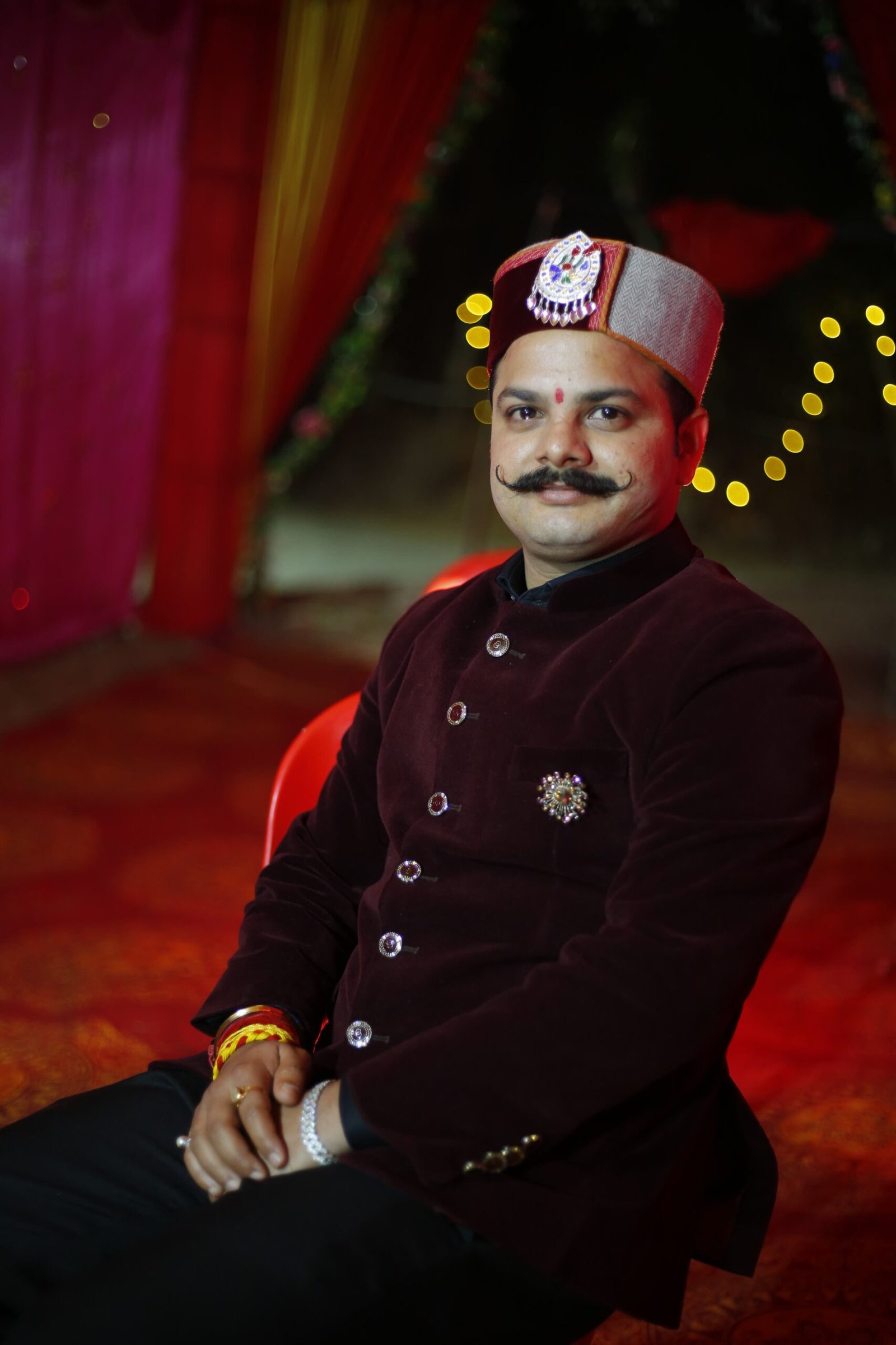
Eshan Pathania, Founder and Managing Trustee
Why this trust exists
Eshan Pathania, our founder and managing trustee, has been in recovery himself for five years. He kept seeing the same thing in Himachal: families selling land or taking loans for rehab fees, or sending sons to places with no doctor where people were locked up and beaten.
His answer was a registered charitable trust rather than a business, with one rule: proper psychiatrist-led treatment at a fee an ordinary Himachali family can actually pay, stated openly from the first phone call. We are not a government centre and we never claim to be. Our fees are written down below so you can compare them with anyone.
In the vocabulary of this article on the difference between rehab centre and nasha mukti kendra, we are a registered private trust run residential centre, and under the Mental Healthcare Act we are a mental health establishment. We call ourselves a drug de-addiction and rehabilitation centre because we do both parts: the medically supervised detox and the months that follow.
Our fees, stated plainly
| Plan | Room and diet | Fee |
|---|---|---|
| Shared Residential Care | Shared room, standard diet | ₹12,500 per month |
| B Caring | Deluxe room, twin sharing, upgraded diet | ₹25,000 per month |
| A Caring | Private room, single occupancy, upgraded diet | ₹40,000 per month |
| Medically supervised detox | Once, at admission | ₹6,000 one time |
The treatment is the same in every plan. Only the room and the diet change. Every plan includes accommodation and meals, prescribed medicines, doctor and psychiatrist reviews, counselling, group therapy, yoga, fitness, all activities and family counselling. Anything outside the centre, such as a hospital referral or transport, is discussed with the family first. If ₹12,500 is still out of reach, please call anyway and tell us honestly. We reduce fees where we genuinely can.
What families can verify about us
- HP State Mental Health Authority, Shimla: Provisional Registration Sr. No. 193, under Sections 66(4) and 66(11) of the Mental Healthcare Act 2017, issued 14/05/2026. The certificate can be inspected at the centre.
- Registered charitable trust: Regd. No. 2025/19/IV/123.
- A 180 day residential programme in eight stages, starting with medically supervised detox.
- A team that includes a psychologist, MSW counsellors, a pharmacist, a staff nurse, a yoga and wellness instructor and a vocational trainer.
- No beating, no chains, no locked rooms and no forced pick-up. Families are encouraged to visit.
- Open 24x7 for calls and WhatsApp on +91 62304 15581.
Who we can admit
Our centre is residential and for men only, aged 18 and above, with no upper age limit. We treat chitta (चिट्टा), heroin, smack, brown sugar, sharab (शराब), charas (चरस), ganja, bhang (भांग), opium, doda, bhukki, tramadol, codeine syrup, alprazolam, cocaine, MDMA, injecting use and mixed use. The daily routine starts with yoga at 6 am, and our page on yoga for stress and anxiety explains why that part is not decoration.
Questions Families Ask About the Difference Between Rehab Centre and Nasha Mukti Kendra
What is the difference between rehab centre and nasha mukti kendra?
In everyday Indian use there is no real difference. All three describe places that treat alcohol and drug dependence, and no law reserves one name for one kind of place. Where a shade of difference exists, de-addiction leans towards short medical detox, rehabilitation leans towards the longer months of therapy afterwards, and nasha mukti kendra is simply the Hindi name used for both. Under the Mental Healthcare Act, 2017 all three are the same legal category: a mental health establishment that must be registered.
Is a nasha mukti kendra the same as rehab?
Yes, in normal usage. The difference between rehab centre and nasha mukti kendra is a matter of language: nasha mukti kendra is the Hindi phrase and rehab is the shortened English one. The word on the board does not tell you whether the place is registered, whether a psychiatrist sees residents, or how long the programme runs, which are the things that actually matter.
What does nasha mukti kendra mean in English?
Nasha means intoxicant or substance, mukti means freedom or liberation, and kendra means centre. So it translates roughly as de-addiction centre or freedom from addiction centre. It is used for alcohol and for drugs alike.
Is a de-addiction centre only for detox?
Not necessarily. The phrase came from government programmes that focused on medical detox inside hospitals, so it often carries that meaning. But many long stay residential centres also call themselves de-addiction centres. Ask directly how many days or months the programme runs rather than guessing from the name.
What is the legal name for a nasha mukti kendra in India?
A mental health establishment. The Mental Healthcare Act, 2017 includes mental conditions associated with alcohol and drug abuse inside the definition of mental illness, and defines a mental health establishment as any health establishment, by whatever name called, meant wholly or partly for the care of persons with mental illness. Section 65 of the Act makes registration with the State Mental Health Authority compulsory.
What is an IRCA?
An Integrated Rehabilitation Centre for Addicts, funded by the Ministry of Social Justice and Empowerment under the National Action Plan for Drug Demand Reduction. It is usually run by an NGO, trust or Red Cross society, and under the scheme the in-patient treatment, stay and food are free of cost. The Red Cross centre at Nurpur in Kangra district is registered as an IRCA.
What is a DDAC?
A District De-Addiction Centre, the current one-stop model from the same ministry. A DDAC brings an Integrated Rehabilitation Centre for Addicts, an Outreach and Drop In Centre and a Community based Peer Led Intervention together under one roof, so that prevention, day services and residential treatment sit in the same building. All of it is free of cost.
What is an ATF or Addiction Treatment Facility?
An Addiction Treatment Facility is set up inside an existing government hospital, funded fully by the Ministry of Social Justice and Empowerment and coordinated nationally by the National Drug Dependence Treatment Centre at AIIMS. Outpatient treatment is the essential component of an ATF, with inpatient beds available at some sites only. Himachal's first ATF opened at Kullu Regional Hospital in Bhuntar in 2022.
What is an OST centre, and is it a nasha mukti kendra?
An Opioid Substitution Therapy centre runs inside a government hospital under the National AIDS Control Organisation, with a doctor, nurse and counsellor. A person dependent on opioids takes a long acting medicine daily under supervision, free of cost, along with counselling. It is a long term outpatient treatment rather than a residential nasha mukti kendra, and for some people it is the right answer.
Is a hospital psychiatry department the same as a de-addiction centre?
Not the same, but it does much of the same work. A psychiatry department treats addiction alongside depression, anxiety and other illnesses, prescribes medicines free from the essential drug list at government hospitals, and can admit someone for detox where beds allow. At Dr RPGMC Tanda there is a weekly drug de-addiction clinic every Tuesday within the psychiatry department.
Which is better, a rehab centre or a de-addiction centre?
Neither word makes a place better, which is the honest answer to the difference between rehab centre and nasha mukti kendra. What makes a difference is whether detox is medically supervised, whether a named psychiatrist is involved, how long the programme runs, whether family counselling is included and whether there is aftercare. A short medical detox and a long rehabilitation programme are both needed by most people, in that order.
How long is detox, and how long is rehabilitation?
Detox usually takes roughly one to two weeks, depending on the substance and how long it was used. Rehabilitation is measured in months, not weeks, because habits, friendships and triggers built over years do not change in a fortnight. Government residential stays are often around one month, while the programme at Eshan Charitable Trust runs for 180 days in eight stages.
Does the name on the board tell me anything about quality?
Almost nothing, and that is the real lesson in the difference between rehab centre and nasha mukti kendra. The same building in Kullu is described as an Integrated Drug Prevention and Rehabilitation Centre, an Addiction Treatment Facility and the sarkari nasha mukti kendra, and all three are accurate. Treat the board as a label and the registration certificate as the evidence.
How do I check whether a nasha mukti kendra is registered in Himachal?
Ask the centre for its Himachal Pradesh State Mental Health Authority registration certificate, write down the number, and confirm it with the authority in Shimla. The authority also publishes a register of mental health establishments. Eshan Charitable Trust holds Provisional Registration Sr. No. 193, which can be inspected at the centre.
What happens if a centre is not registered?
Running a de-addiction centre in Himachal without registering it with the state mental health authority can attract a penalty of up to ₹5 lakh, and the state has said a criminal case can be registered against the operators if a patient dies at such a centre. Please do not admit anyone to an unregistered place at any price.
What is a halfway home?
A supported place to live after the main treatment programme, for someone who is stable but not yet ready to return to the same street and the same friends. There are fewer rules than in a treatment centre and more structure than at home. They are still rare in Himachal.
Is a nasha mukti kendra only for drugs, or for alcohol too?
For both. Despite the name, alcohol dependence is treated at the same centres, and sharab is one of the most common reasons families call us. Stopping heavy daily drinking suddenly can cause seizures, so alcohol detox should always be medically supervised.
Can someone be admitted to a nasha mukti kendra by force?
Admission is normally voluntary under the Mental Healthcare Act, 2017. Admission without consent is allowed only in limited situations, after assessment by qualified mental health professionals and with legal safeguards. A centre offering to collect a grown man against his will is not offering treatment. Speak to a psychiatrist about what is allowed in your situation.
Are government centres called something different from private ones?
Government funded centres often carry a scheme name such as IRCA, DDAC, ODIC, CPLI or ATF, which private centres do not use. Beyond that there is no naming rule. Both kinds use the words de-addiction, rehabilitation and nasha mukti kendra freely, and both must be registered with the state mental health authority.
Which type of centre should I call first in the Kangra valley?
If cost is the main problem, start with the psychiatry OPD at Dr RPGMC Tanda and the District Red Cross Society de-addiction centres in the district, and ring the free helpline 14446. If you need admission within a day or two, or a programme of several months, you can call Eshan Charitable Trust in Tanda Kholi on +91 62304 15581 at any hour, even if it is only to ask questions.
What is the nasha mukti kendra number to call?
For free national help, the de-addiction helpline number is 14446 and Tele MANAS is 14416, both toll free and available in your own language. For an ambulance in an emergency, call 108. Our own number at Eshan Charitable Trust is +91 62304 15581, answered 24x7 on call and WhatsApp, and you are welcome to ring it about someone who has not agreed to treatment yet. Before calling any private centre, ask for its registration number under the Mental Healthcare Act 2017 and check it with the state mental health authority.
Is Eshan Charitable Trust a rehab centre or a nasha mukti kendra?
Both words describe us, and we use them both. Formally we are a registered private charitable trust running a drug de-addiction and rehabilitation centre, which under the Mental Healthcare Act is a mental health establishment. We are not a government centre and we never claim to be.
A Last Word for the Family
If you came looking for the difference between rehab centre and nasha mukti kendra hoping one of the names would turn out to be the safe one, we are sorry to disappoint you. There is no magic word. But there is something better, which is a short list of questions that works on every centre in the state, and you now have it.
So stop weighing the difference between rehab centre and nasha mukti kendra and ask these instead. Ask for the registration. Ask for the psychiatrist's name. Ask how long the programme runs and what happens in month three. Ask to visit. Any place that answers those four properly is worth considering, whatever is painted on the gate. Any place that dodges them is not, however reassuring the board looks.
Call the helplines, visit the OPD at Tanda, and call us too if you like, even if you never admit anyone here. Nobody will pressure you, and asking costs nothing.
Sources and References
Every scheme name, legal provision, figure and date in this guide comes from the sources below. We have not named any patient, arrested person or family from any news report.
- Government of India. The Mental Healthcare Act, 2017, India Code.
- Indian Journal of Psychiatry. Mental Healthcare Act, 2017, and addiction treatment.
- Himachal Pradesh State Mental Health Authority. Register of private mental health establishments.
- Himachal Pradesh State Mental Health Authority. About, mental health facilities in the state.
- Ministry of Social Justice and Empowerment. National Action Plan for Drug Demand Reduction.
- Ministry of Social Justice and Empowerment. NAPDDR treatment centre portal: IRCA, ODIC, CPLI and DDAC.
- Ministry of Social Justice and Empowerment. e-Anudaan portal, notices inviting proposals for District De-Addiction Centres.
- Ministry of Social Justice and Empowerment. Nasha Mukt Bharat Abhiyaan.
- NDDTC, AIIMS. Addiction Treatment Facilities scheme.
- Press Information Bureau. De-Addiction Programme, Ministry of Health and Family Welfare, March 2022.
- Drug De-Addiction Programme, MoHFW. Scheme for strengthening of drug de-addiction services.
- National AIDS Control Organisation. Opioid Substitution Therapy under the National AIDS Control Programme.
- Ministry of Health and Family Welfare. Tele MANAS, National Tele Mental Health Programme.
- World Health Organization. Opioid overdose, fact sheet.
- Dr Rajendra Prasad Government Medical College, Tanda. Department of Psychiatry.
- The Tribune. Registration must for de-addiction centres.
- The Tribune. 14 Himachal de-addiction centres close down during pandemic.
- The Tribune. Unregistered rehab centres to be penalised.
- The Tribune. CM launches portal listing rehabilitation centres, standards for registered centres.
- The Tribune. This rehabilitation centre revolutionises addiction treatment, Bhuntar, Kullu.
- The Tribune. Lack of govt rehab centres in Kangra worsens drug crisis.
- National Informatics Centre. Drug Free Himachal mobile app.

Dr. Devasheesh Sharma, MBBS, DNB (Psychiatry)
Psychiatrist. Himachal Pradesh Medical Council Reg. No. 5263.
Dr. Aditya Thakur, MBBS
Registered medical practitioner. Himachal Pradesh Medical Council Reg. No. 6218.
Eshan Charitable Trust Team
The counsellors and staff at our nasha mukti kendra in Kangra, who explain these differences to families every day. Last reviewed on 2 October 2026. More answers are on our frequently asked questions page.
This guide is for information and support. It does not replace a consultation with a doctor or psychiatrist who can examine the person you are worried about.