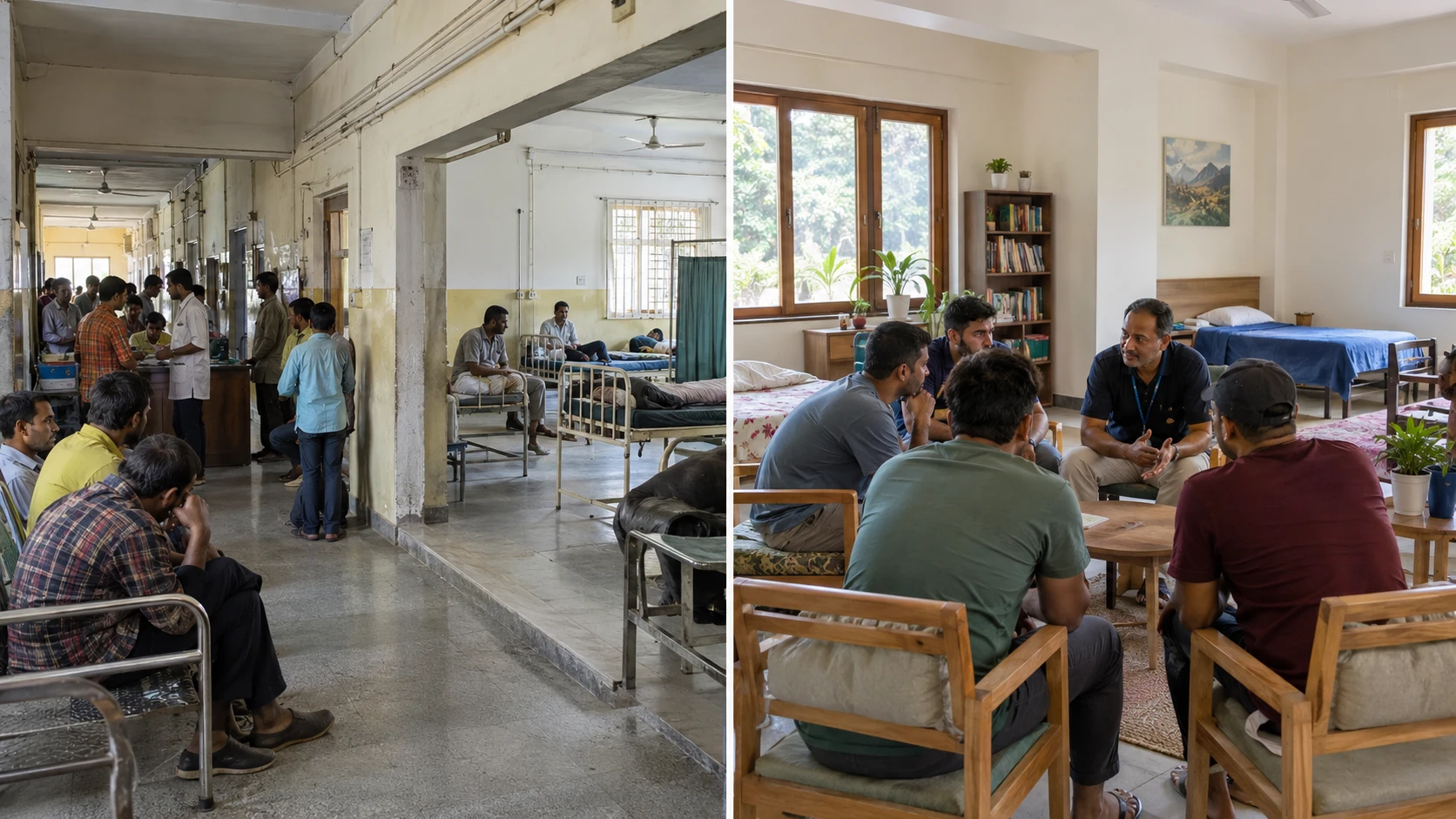
Almost every family that calls us asks the same question in the first two minutes: should we take him to a sarkari centre or a private one? Government vs private nasha mukti kendra is not a simple good versus bad choice. It is a choice about cost, about how long you can wait for a bed, and about what happens after detox is over.
This guide sets the two side by side, honestly. We will not tell you that government centres are bad, because that is not true. The psychiatry departments at Himachal's government medical colleges are run by qualified doctors, the medicines there are free, and some government backed centres in this state are doing genuinely good work. We will also not tell you that every private centre is better, because that is definitely not true either. Some of the worst places in Himachal have been private ones.
What we will do is give you the actual numbers, the actual bed counts, the actual waiting position in Kangra district, and a checklist you can use on either kind of centre. This page is published by Eshan Charitable Trust, a registered nasha mukti kendra in Kangra. We are a private charitable trust, so we have included ourselves where it is relevant. Everything here is based on publicly available information and on our team's own enquiries, and details change, so please confirm before you admit anyone anywhere.
- Cost. Government and Red Cross de-addiction centres are free or close to free. Private nasha mukti kendra fees in Himachal usually run from about ₹12,500 to ₹40,000 a month, and far more in metro cities.
- Waiting time. Government OPD is usually same week. A government bed depends on availability, and Kangra district has very few of them. Private centres normally admit within a day or two.
- Detox versus rehab. Government centres are strong on medical detox and free medicines. The longer rehabilitation phase after detox is where most families find the gap.
- Registration is the real test. Government or private, ask for the Himachal Pradesh State Mental Health Authority registration number and check it. Running a centre without it can attract a penalty of up to ₹5 lakh.
- Do not wait for the perfect option. Start with the free helpline 14446 or 14416, or the psychiatry OPD at Tanda. Getting him seen this week matters more than choosing the perfect centre next month.
Government vs Private Nasha Mukti Kendra: What Each One Actually Is
The words get used loosely, so let us be clear about what you are actually choosing between. In Himachal, four different kinds of places treat addiction, and only two of them are what people mean by "sarkari".
1. Government hospital psychiatry departments
Tanda medical college, IGMC Shimla, zonal and civil hospitals. These are run by the Health Department with qualified psychiatrists. They handle medical detox, prescribe medicines, treat depression and anxiety alongside addiction, and run opioid substitution treatment.
The psychiatry department at Dr RPGMC Tanda runs mental health services round the clock and holds a special drug de-addiction clinic every Tuesday, serving patients from almost eight districts.
2. Government funded de-addiction and rehabilitation centres
Usually run by the District Red Cross Society or an NGO, funded under the central Nasha Mukt Bharat scheme or by the state Social Justice and Empowerment Department. This is the true sarkari nasha mukti kendra most people mean.
Under the Ministry of Social Justice and Empowerment's National Action Plan for Drug Demand Reduction, an Integrated Rehabilitation Centre for Addicts offers in-patient treatment with stay and food free of cost.
3. Registered private and trust run centres
Independent centres that charge a fee and must be registered with the Himachal Pradesh State Mental Health Authority. Some are commercial, some are charitable trusts like ours. Quality varies a great deal, so the registration certificate and the staff list matter more than the brochure.
4. Unregistered centres
Places running without HPSMHA registration. These are the ones behind most of the horror stories: no psychiatrist, locked rooms, force. They are not "cheap private rehab". They are illegal, and the state has said operators can face a penalty and, if a patient dies, a criminal case.
A word on language. Nasha mukti kendra, de-addiction centre and rehab centre all mean roughly the same thing in India. What separates a safe place from an unsafe one is not the name on the board. It is the registration, the doctor, and whether the family is allowed to visit.
Himachal's Real Picture: How Many Centres, How Many Beds
Before you compare cost, it helps to know how small the government system still is in this state. These are the figures officials themselves have shared.
government de-addiction and rehabilitation centres for men operating in Himachal, in Kullu, Una, Hamirpur and Kangra, plus one for women run by the Red Cross in Kullu. Source: The Tribune
beds recorded for the two Red Cross de-addiction centres in Kangra district on the state mental health authority's own register, at Dharamshala and Nurpur. Source: HPSMHA register
private de-addiction and rehabilitation centres functioning in Himachal when the state mental health authority last shared a count, in September 2021. Source: The Tribune
maximum penalty ordered for running a de-addiction centre in Himachal without registering it with the HPSMHA. Source: The Tribune
Put simply: the government stream in Himachal has a small number of beds spread thinly across a hilly state, and a much larger number of private beds whose quality is uneven. That is the honest starting point for any government vs private nasha mukti kendra decision.
The state is aware of the gap. Chief Minister Sukhvinder Singh Sukhu said in June 2026 that while medical treatment for addiction was already available at institutions like IGMC Shimla, there was a significant gap in the rehabilitation process after treatment. That single sentence explains what most Himachali families experience: detox is available, the six months after detox is the hard part.
Cost: What a Government and a Private Nasha Mukti Kendra Actually Charge
This is the first question for nearly every family, and it is a fair one. Selling land or taking a loan for rehab is common in Himachal, and it should not have to be.
What government and Red Cross centres charge
Free, or very close to it. Under the central scheme, a District De-Addiction Centre and its Integrated Rehabilitation Centre for Addicts provide in-patient treatment, stay and food at no charge. At the government de-addiction centre in Bhuntar, Kullu, The Tribune reported that patients are seen in the OPD from 10 am to 4 pm, are given free medicines, and that the fifteen bed unit offers free residential care for one month.
The law backs this up. Under the Mental Healthcare Act, 2017, medicines on the essential drug list must be free at government run or funded mental health establishments, and people living below the poverty line, or who are destitute or homeless, are entitled to treatment free of any charge, even without a BPL card.
What private centres in Himachal charge
There is no regulated price. Based on our team's own enquiries around Kangra, Palampur and Kullu, ordinary residential centres in Himachal quote roughly ₹15,000 to ₹30,000 a month, and a few quote less. Premium centres in Delhi, Goa and the south run into lakhs per month. Our own fees are listed further down, and our detailed breakdown of rehab centre fees in Himachal Pradesh goes through this market centre by centre.
| Type of centre | Typical monthly cost | What that usually covers |
|---|---|---|
| Government hospital psychiatry OPD | Free, small registration fee only | Doctor consultation, essential list medicines, lab tests, referral |
| Government or Red Cross de-addiction centre | Free or nominal | Detox, stay, food, counselling, usually a short stay of about one month |
| Trust run centre such as Eshan | ₹12,500 to ₹40,000 | Detox, stay, food, medicines, psychiatrist reviews, counselling, yoga, family sessions |
| Standard private centre in Himachal | About ₹15,000 to ₹30,000, per our enquiry | Varies widely, always ask what is written in the fee sheet |
| Premium or metro centre | ₹1 lakh and above | Private rooms, larger therapy teams, resort style facilities |
The honest version of the cost question. If money is the main barrier, a government or Red Cross centre is the right first call and there is no shame in it whatsoever. If you can pay something but not a lot, look for a charitable trust rather than assuming you must choose between free and expensive. And if a private centre cannot give you its fees in writing before admission, that is a warning sign no matter what the figure is.
Waiting Time: How Fast Can He Actually Get In?
This is where the government vs private nasha mukti kendra choice usually gets decided, because addiction does not wait politely. A young man who agrees to treatment on Tuesday may change his mind by Friday.
Government: OPD is quick, a bed is not guaranteed
Getting seen is usually fast. A psychiatry OPD at a government medical college or zonal hospital will see him within days, and the Tanda de-addiction clinic runs weekly on Tuesdays. Medicines are handed over the same day.
An in-patient bed is a different matter. Kangra district, the most populous district in Himachal, has two Red Cross de-addiction centres on the state register with fifteen beds each. That is the capacity for a district of well over fifteen lakh people. The Tribune has reported that the Nurpur centre lacked an adequate number of beds and facilities, and that families were therefore admitting their sons to private centres elsewhere in Nurpur or outside the state. A separate Tribune report found that the shortage of de-addiction centres was holding back the Saarthi scheme in Nurpur subdivision.
So the realistic position is this: government OPD, days. Government detox bed, depends entirely on whether a bed is free that week. Long government rehabilitation of several months, very limited in Kangra at the moment, though that is changing with the new centre approved at Tanda.
Private: usually one or two days
A registered private centre will normally assess him by phone the same day and admit within a day or two. That speed is the main thing families are paying for, along with the length of the programme. At Eshan Charitable Trust, admission is usually possible within a day or two of your first call, and you can ask every question you want before you commit to anything.
Some centres use urgency as a sales tool: "bring him tonight, we will send a vehicle". Forced pick-up is not treatment. Under the Mental Healthcare Act, admission is normally voluntary, and admission without consent is allowed only in limited situations after assessment by qualified mental health professionals. If a centre offers to collect a grown man against his will, walk away, however fast they promise to be.
Facilities and Staff: Where Government Is Strong and Where Private Is
Facilities are not just rooms and food. What matters is who examines him, what happens in a day, and what happens in month three when the withdrawal is long over but the cravings are not.
What government centres do well
- Qualified psychiatrists at medical colleges and district hospitals
- Free medicines from the essential drug list
- Opioid substitution treatment where it is the right choice
- A full hospital on the same campus for HIV, hepatitis C, TB and liver problems
- No profit motive, so nobody is selling you an upgrade
- Strong confidentiality rules, which matter in a small town
Where government centres are stretched
- Very few residential beds, so admission depends on the week
- Stays are often about a month, which covers detox but not full rehab
- Staff vacancies at some centres, reported by local media
- Limited one to one counselling time when the OPD is crowded
- Family counselling and structured aftercare are usually thin
What good private centres do well
- Admission within a day or two, without waiting for a bed to free up
- Long programmes, often three to six months, with a written plan
- Daily one to one counselling and group therapy
- Family counselling built into the programme
- Yoga, fitness, vocational training and a fixed daily routine
- Aftercare calls and a relapse prevention plan for home
Where private centres go wrong
- Cost, which is the whole problem for most Himachali families
- No psychiatrist on record at some centres
- Unregistered places using locked rooms and force
- Fees quoted verbally and then increased
- Marketing language like "100 per cent cure", which no honest centre can promise
The minimum standards are not a mystery. The state mental health authority has said registered centres must provide 75 to 100 square feet of space per person, facilities for sports, yoga and meditation, qualified staff and a medical officer or psychiatrist on call, and must follow Rehabilitation Council of India criteria and WHO recommended treatment protocols. You are allowed to ask whether a centre meets these, government or private.
Government vs Private Nasha Mukti Kendra: The Full Comparison Table
Here is everything in one place. Use it as a checklist when you call either kind of centre.
| What you are comparing | Government or Red Cross centre | Registered private or trust centre |
|---|---|---|
| Monthly cost | Free or nominal | Paid, commonly ₹12,500 to ₹40,000 in Himachal |
| Medicines | Essential list medicines free by law | Usually included in the fee, confirm in writing |
| Time to get seen | OPD within days | Phone assessment the same day |
| Time to get a bed | Depends on availability, can take time | Usually one to two days |
| Typical length of stay | Often about one month | Three to six months in longer programmes |
| Doctor cover | Psychiatrist at medical colleges, varies at smaller centres | Varies, always ask for names and registration numbers |
| Counselling time | Group sessions, limited one to one when busy | Daily one to one plus group, in good centres |
| Family counselling | Offered at some centres | Usually a formal part of the programme |
| Rooms and food | Basic, clean, dormitory style | Shared to private rooms, depending on what you pay |
| Aftercare | Follow-up at some centres, informal at others | Structured follow-up calls and visits in good centres |
| Regulation | Government funded and inspected | Must hold HPSMHA registration, ask to see it |
| Best suited to | Families with no budget, and anyone needing medical detox fast | Families who need immediate admission and a long programme |
Many families use both, and that is often the smartest route. Start with the government psychiatry OPD or a Red Cross centre for the medical detox, then move to a longer residential programme for the rehabilitation months. There is no rule that says you must pick one system and stay in it.
What Has Changed in Himachal's Government De-Addiction System
The picture is not frozen. Here is what has actually happened, with dates, so you can judge for yourself.
- 2017The District Red Cross Society, Kangra, starts a De-Addiction and Rehabilitation Centre at Nurpur, as later confirmed by UNI.
- 2022Himachal's first Addiction Treatment Facility opens at Bhuntar in Kullu, in collaboration with the National Drug Dependence Treatment Centre of AIIMS, with separate buildings of 15 beds for women and 20 for men and daily outpatient services. The Tribune reported that 80 per cent of registered cases there involve heroin, mostly from Una and Kangra.
- October 2025The state moves on the long delayed Kotla Barog project in Sirmaur after the Governor raised concern about the condition of rehabilitation facilities. A 100 bed centre with a library, gymnasium, sports facilities and skill training is sanctioned at ₹5.34 crore, as reported by HimbuMail.
- November 2025The District Red Cross Society, Kangra, begins running a District De-Addiction Centre at Prayas Bhawan in Dharamshala.
- December 2025At an anti-chitta walkathon in Bilaspur, the Chief Minister said over ₹20 crore had been released for the de-addiction and rehabilitation centre at Kotla Barog, The Tribune reported.
- 8 June 2026The Nav Jeevan women's de-addiction and rehabilitation centre opens at Mashobra near Shimla, the first government run centre in Himachal exclusively for women. A second government centre is approved at Dr RPGMC Tanda in Kangra, as reported by The Tribune.
- August 2026At a state workshop, the Social Justice and Empowerment Minister repeats that four de-addiction and rehabilitation centres for men are operating, in Kullu, Una, Hamirpur and Kangra, plus the Red Cross women's centre in Kullu, Himachal Headlines reported.
Alongside this, 108 "Disha" counselling and early intervention centres have been set up in health institutions across Himachal, and five more de-addiction centres are being established in Mandi, Lahaul-Spiti, Chamba, Solan and Sirmaur. If you live in Chamba, our page on the nasha mukti kendra in Chamba covers what is available there now.
Our separate guide to every government nasha mukti kendra in Himachal Pradesh lists these centres district by district with the contact details we could verify.
Government Nasha Mukti Kendra Options in and Around Kangra
If you are in the Kangra valley, these are the government and Red Cross options worth knowing before you look at private centres.
| Centre | What it offers | Contact |
|---|---|---|
| District De-Addiction Centre, Prayas Bhawan, Dharamshala | Run by the District Red Cross Society, Kangra, since November 2025. Treatment under specialist doctors and counsellors, with yoga, meditation, individual, group and family counselling | 01892-224408 |
| De-Addiction and Rehabilitation Centre, Nurpur | Red Cross centre running since 2017, listed with 15 beds on the state register | 01893-221200 |
| District Red Cross Society office, Dharamshala | General enquiries and referral | 01892-224888 |
| Dr RPGMC Tanda, Department of Psychiatry | Round the clock mental health services, special drug de-addiction clinic every Tuesday, tobacco cessation clinic on Wednesdays. A new government de-addiction and rehabilitation centre has been approved here | Via hospital OPD registration |
| Disha counselling centres | 108 counselling and early intervention centres in health institutions across Himachal | Ask at your nearest health institution |
| Nav Jeevan Women's Centre, Mashobra | Himachal's first government run de-addiction and rehabilitation centre for women | Via Tele MANAS 14416 for guidance |
Please ring ahead. Bed availability, timings and staffing change, and a phone call today is worth more than anything written on a website, including this one.
Families in the surrounding towns can also read our local pages for the rehab centre in Dharamshala, the rehab centre in Palampur and the rehab centre in Nurpur, which list the nearest options for each area.
How to Get Into a Government De-Addiction Centre, Step by Step
Nobody hands you a printed process, so here is the route that works for most families in Himachal.
- Call a free helpline firstRing 14446, the national de-addiction helpline, or 14416 for Tele MANAS. Explain the situation and ask what is available near your district today.
- Go to the psychiatry OPDTake him to the psychiatry department at Tanda, IGMC or your zonal hospital. At Tanda the drug de-addiction clinic runs on Tuesdays. Carry an ID and any earlier prescriptions.
- Let the doctor assess him properlyTell the doctor everything: chitta, sharab, charas, pills, how much and for how long. Mixed use changes how detox must be done, so nothing should be hidden out of shame.
- Ask directly about admissionAsk whether a de-addiction bed is available, how long the stay would be, and what happens after discharge. Ask the same question at the Red Cross centre in Dharamshala or Nurpur.
- Ask about free treatment if money is tightIf the family is below the poverty line, destitute or homeless, treatment at government run or funded mental health establishments is free by law, even without a BPL card.
- If there is no bed, do not stop thereStart outpatient medication and counselling the same week, and put his name down for a bed. An OPD start is far better than waiting at home for a month.
- Plan the rehabilitation months now, not laterDetox is roughly a week. Decide in advance whether the months after that will be at home with regular follow-up, at a longer residential centre, or a mix of both.
If he already has a police case for consumption of a small quantity, ask a lawyer about Section 64A of the NDPS Act, which protects a user from prosecution if he volunteers for de-addiction treatment at a hospital or institution run or recognised by the government and completes it.
How to Check a Private Nasha Mukti Kendra Before You Admit Anyone
We are a private centre, and we will still say this plainly: the private sector in Himachal has produced some genuinely bad places, and families have paid for it. The checks below take twenty minutes and they matter more than the photos on any website.
What the record actually shows
Registration with the Himachal Pradesh State Mental Health Authority is compulsory, because substance use problems count as mental illness and de-addiction centres are mental health establishments. Unregistered centres can face a penalty of up to ₹5 lakh, and the state has said a criminal case can follow if a patient dies at one.
In 2021 the authority reported that fourteen private centres had shut down in eighteen months, five each in Solan and Una, two in Kangra and one each in Mandi and Shimla, and its chief executive said that inhuman behaviour, threats and physical force had been reported at some centres in the name of rehabilitation. In Una, police found centres holding 50 men where permission was only for 25. A Tribune investigation in Kangra found centres running without proper licences or psychiatrists, with allegations of abuse and hefty unregulated fees.
A ten point check you can do on any centre
- An HPSMHA registration certificate, shown to you, with a number you can note down and verify
- A named psychiatrist who reviews residents, and a doctor reachable in an emergency
- Medically supervised detox, not "cold turkey" in a locked room
- Trained staff: a psychologist, counsellors, a nurse and a pharmacist
- A written treatment plan and a clear programme length
- Fees in writing, with what is included and what is not
- Family counselling, and a stated policy on visits and phone calls
- Clean rooms, proper food, and space for exercise and fresh air
- Aftercare and follow-up after discharge
- Straight answers, with no talk of a guaranteed cure
Red flags: walk away if you see these
- Claims of a 100 per cent cure, or a fixed success rate
- A pickup service that takes people by force
- No doctor or psychiatrist named anywhere
- Refusing to show the registration certificate
- Families never allowed to visit or call
- Cash only, with no receipts
- Chains, locked rooms, or any sign of beatings
Our guide to picking the best rehabilitation centre in Himachal Pradesh goes into each of these checks in more detail, including what to look at during a visit.
Which One Suits Your Family: A Simple Guide
There is no universal answer, so here is a practical one based on the situations families actually describe to us.
| Your situation | Where to start |
|---|---|
| You cannot pay anything right now | Government psychiatry OPD, Red Cross de-addiction centre, helpline 14446. Free treatment at government establishments is a legal right for BPL and destitute families |
| He is very unwell today, vomiting or confused, or drinking heavily | Hospital first. Alcohol withdrawal after heavy daily drinking can cause seizures and needs medical supervision. Call 108 if it is an emergency |
| He has agreed today and may change his mind tomorrow | A registered private or trust centre that can admit within a day or two |
| He has relapsed after a short stay somewhere | A longer programme of several months with proper counselling and aftercare |
| He also has depression, anxiety or a serious physical illness | A government medical college first for a full assessment, then decide on the rehab months |
| You can pay something, but not a lot | A charitable trust centre, and tell them your actual budget. Many will work with you |
| The person needing help is a woman | The Nav Jeevan centre at Mashobra, or the Red Cross women's centre in Kullu. Call 14416 for guidance |
Whatever you choose, the thing that predicts recovery best is not the price tag. It is medical detox done safely, a long enough programme, a family that stays involved, and follow-up after he comes home. Our article on the psychology of addiction explains why those four things matter so much, and yoga for stress and anxiety covers the daily routine side of recovery.
Free Helplines and Government Services Worth Saving
Save these in your phone today, whichever kind of centre you eventually choose.
| Number or service | What it is for |
|---|---|
| 14446 | National toll-free de-addiction helpline under the Nasha Mukt Bharat Abhiyaan, for counselling and referral |
| 14416 or 1-800-891-4416 | Tele MANAS: free 24x7 mental health support from the Government of India, in your own language |
| 112 | Emergency response for police, fire and ambulance |
| 108 | Ambulance for medical emergencies, including an overdose |
| 1933 | MANAS helpline of the Narcotics Control Bureau, to report drug trafficking |
| Drug Free Himachal app | Himachal Police app to report drug selling without revealing your name |
If you are dealing with a suspected overdose right now, do not read further. The World Health Organization says an opioid overdose can be recognised by three signs together:
Call 108 or 112 immediately, turn him on his side if he is breathing, and stay with him until help arrives. Our guide for families on what to do when someone at home is using chitta has the full first aid steps.
Nasha Mukti Kendra Near Me: What "Near" Should Really Mean
Most families type "nasha mukti kendra near me" or "rehab near me" at their lowest moment, and the first result is not always the right one. Near matters for a real reason: parents and wives need to be able to visit and join family counselling. But a little distance from his old friends, his dealer and his usual routes also helps in the first months.
Eshan Charitable Trust is at Village Tanda Kholi, near the FCI godown and close to Dr Rajendra Prasad Government Medical College, Tanda, in Kangra district. Families come to us from across the valley, and also from Chamba, Hamirpur, Mandi and Una.
Myths About Government and Private Nasha Mukti Kendra
Myth: "Government centres are useless."
Not true. Government psychiatry departments have qualified doctors and free medicines, and the Bhuntar centre in Kullu has been praised in the press for its work. The real limit is the number of residential beds, not the quality of the doctors.
Myth: "Private means better."
Private means paid. Some private centres in Himachal have been shut after deaths and overcrowding. Check the registration and the staff, not the price.
Myth: "Free treatment means poor treatment."
Free government treatment is a legal entitlement, not charity, and the medicines used are the same ones a private doctor would prescribe.
Myth: "Expensive centres have better success rates."
No honest centre in India publishes a verified success rate. If one quotes you a percentage, ask where the number comes from.
Myth: "Fifteen days is enough."
Fifteen days covers detox. The habits, friendships and triggers built over years need months, which is why longer programmes exist.
Myth: "We must choose one system and stick to it."
Plenty of families detox at a government hospital and then do the rehabilitation months elsewhere. Mixing the two is completely normal.
Where Eshan Charitable Trust Fits Between Government and Private
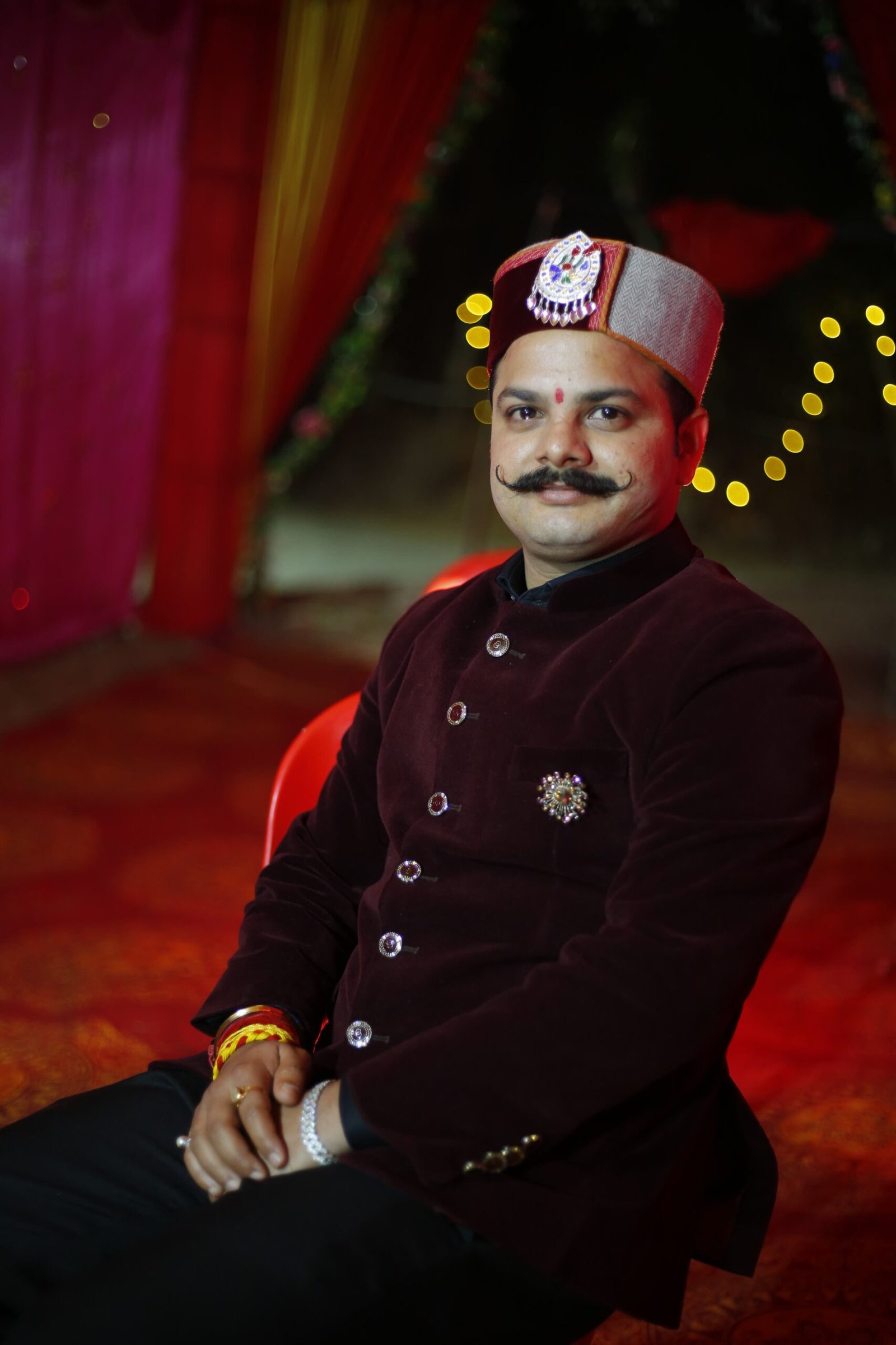
Eshan Pathania, Founder and Managing Trustee
Why this trust exists
Eshan Pathania, our founder and managing trustee, has been in recovery himself for five years. He kept seeing the same thing in Himachal: families who could not afford private rehab fees, so their sons went without treatment or ended up somewhere unsafe.
His answer was a registered charitable trust rather than a business, with one rule: proper psychiatrist-led treatment at a fee an ordinary Himachali family can actually pay, stated openly from the first phone call. We are not a government centre and we never claim to be. We sit between the free government stream and the expensive private one, and our fees are written down below so you can compare them with anyone.
Our fees, stated plainly
| Plan | Room and diet | Fee |
|---|---|---|
| Shared Residential Care | Shared room, standard diet | ₹12,500 per month |
| B Caring | Deluxe room, twin sharing, upgraded diet | ₹25,000 per month |
| A Caring | Private room, single occupancy, upgraded diet | ₹40,000 per month |
| Medically supervised detox | Once, at admission | ₹6,000 one time |
The treatment is the same in every plan. Only the room and the diet change. Every plan includes accommodation and meals, prescribed medicines, doctor and psychiatrist reviews, counselling, group therapy, yoga, fitness, all activities and family counselling. Anything outside the centre, such as a hospital referral or transport, is discussed with the family first. If ₹12,500 is still out of reach, please call anyway and tell us honestly. We reduce fees where we genuinely can.
What families can verify about us
- HP State Mental Health Authority, Shimla: Provisional Registration Sr. No. 193, under Sections 66(4) and 66(11) of the Mental Healthcare Act 2017, issued 14/05/2026. The certificate can be inspected at the centre.
- Registered charitable trust: Regd. No. 2025/19/IV/123.
- A 180 day residential programme in eight stages, starting with medically supervised detox.
- A team that includes a psychologist, MSW counsellors, a pharmacist, a staff nurse, a yoga and wellness instructor and a vocational trainer.
- No beating, no chains, no locked rooms and no forced pick-up. Families are encouraged to visit.
- Open 24x7 for calls and WhatsApp on +91 62304 15581.
Who we can admit
Our centre is residential and for men only, aged 18 and above, with no upper age limit. We treat chitta (चिट्टा), heroin, smack, brown sugar, sharab (शराब), charas (चरस), ganja, bhang (भांग), opium, doda, bhukki, tramadol, codeine syrup, alprazolam, cocaine, MDMA, injecting use and mixed use. Families dealing with drinking alone can also read our guide to alcohol addiction recovery, and anyone trying to stop chitta can start with chitta kaise chhode.
Questions Families Ask About Government vs Private Nasha Mukti Kendra
Government vs private nasha mukti kendra: which one should we choose?
Choose a government or Red Cross centre if cost is the main barrier, because treatment there is free or nominal and the doctors are qualified. Choose a registered private or trust centre if you need admission within a day or two, or a longer programme of several months with daily counselling and family sessions. Many families use both, detoxing in the government system and doing the rehabilitation months elsewhere.
Is treatment really free at a government nasha mukti kendra in Himachal?
At government run and government funded centres it is free or nominal. Medicines on the essential drug list must be provided free at government mental health establishments, and people living below the poverty line, or who are destitute or homeless, are entitled to free treatment even without a BPL card. At the Bhuntar centre in Kullu, for example, patients get free medicines and free residential care for about one month.
How much does a private nasha mukti kendra cost in Himachal?
There is no regulated price. Based on our team's enquiries, ordinary residential centres in Himachal quote roughly ₹15,000 to ₹30,000 a month. Premium centres in metro cities run into lakhs. At Eshan Charitable Trust the monthly fees are ₹12,500, ₹25,000 and ₹40,000 depending on the room, with a one time detox charge of ₹6,000.
How long is the waiting time for a government de-addiction centre bed?
The outpatient department is usually quick, often within days, and the drug de-addiction clinic at Tanda runs every Tuesday. A residential bed depends on availability, and Kangra district has only two Red Cross de-addiction centres listed with 15 beds each. Always phone the centre to ask about beds before travelling.
How quickly can a private nasha mukti kendra admit someone?
Usually within a day or two. A registered private centre will normally assess the situation by phone on the same day and confirm a date straight away. That speed is one of the main reasons families choose private admission when a young man has finally agreed to treatment.
How many government de-addiction centres are there in Himachal Pradesh?
As stated by the state government in 2026, four de-addiction and rehabilitation centres for men are operating, in Kullu, Una, Hamirpur and Kangra, along with a women's centre run by the Red Cross Society in Kullu and the Nav Jeevan women's centre at Mashobra. Five more are being established in Mandi, Lahaul-Spiti, Chamba, Solan and Sirmaur, and a 100 bed centre is being built at Kotla Barog in Sirmaur.
Are government rehab centres in Himachal in bad condition?
It varies by centre, and it would be unfair to say all of them are poor. Government medical college psychiatry departments are staffed by qualified psychiatrists and the Bhuntar centre in Kullu has been reported positively in the press. At the same time, The Tribune has reported staffing and bed shortages at the Nurpur centre. The honest summary is good doctors, too few residential beds.
Is a private rehab centre better than a government one?
Not automatically. A good private centre offers faster admission, longer programmes and more one to one counselling. A poor private centre may have no psychiatrist at all. Some private centres in Himachal have been shut down after inmate deaths and overcrowding. Judge any centre by its registration, its staff and its programme, not by whether it is private.
What is the difference between a de-addiction centre and a nasha mukti kendra?
In practice they mean the same thing. De-addiction centre, rehab centre and nasha mukti kendra are all used for places that treat alcohol and drug dependence. What actually differs is whether the place is registered, whether a psychiatrist is involved, and how long the programme runs.
How do I check whether a nasha mukti kendra is registered in Himachal?
Ask the centre for its Himachal Pradesh State Mental Health Authority registration certificate and write down the number, then confirm it with the authority in Shimla. A genuine centre will show it without hesitation. Eshan Charitable Trust holds Provisional Registration Sr. No. 193, which can be inspected at the centre.
What happens if a centre is not registered?
Running a de-addiction centre in Himachal without registering it with the state mental health authority can attract a penalty of up to ₹5 lakh, and the state has said a criminal case can be registered against the operators if a patient dies at such a centre. Please do not admit anyone to an unregistered place at any price.
Can we start at a government centre and move to a private one later?
Yes, and many families do exactly that. Medical detox at a government hospital or Red Cross centre, then a longer residential programme for the rehabilitation months. Tell the second centre everything about the first, including which medicines were given, so the treatment continues smoothly.
Where can women get de-addiction treatment in Himachal?
The Nav Jeevan Women's De-Addiction and Rehabilitation Centre at Mashobra near Shimla is the state's first government run centre for women, and the Red Cross Society runs a women's centre in Kullu. A second women's centre has been approved at Dr RPGMC Tanda in Kangra. The free Tele MANAS helpline 14416 can guide you.
Is there a government nasha mukti kendra in Kangra district?
Yes. The District Red Cross Society, Kangra, runs a District De-Addiction Centre at Prayas Bhawan in Dharamshala on 01892-224408, and a De-Addiction and Rehabilitation Centre at Nurpur on 01893-221200. Dr RPGMC Tanda also has a psychiatry department with a weekly drug de-addiction clinic, and a new government centre has been approved there.
Do government centres give medicines free?
Yes. Under the Mental Healthcare Act, 2017, all medicines on the essential drug list must be made available free of cost to persons with mental illness at establishments run or funded by the government. Substance use disorders are covered by that Act.
How long should a rehab programme be?
Detox alone takes about a week and only clears the drug from the body. Changing habits, thinking and triggers takes months, which is why many good programmes last several months. Government residential stays are often around one month, while the programme at Eshan Charitable Trust runs for 180 days in eight stages.
Can a family be forced to pay extra after admission at a private centre?
A properly run centre gives you the fees in writing before admission, including what is included and what is not. Ask specifically about detox charges, medicines, hospital referrals and refunds if he leaves early. If a centre will not put its fees in writing, treat that as a warning sign.
Is it legal to take someone to a nasha mukti kendra by force?
Admission is normally voluntary under the Mental Healthcare Act, 2017. Admission without consent is allowed only in limited situations, after assessment by qualified mental health professionals and with legal safeguards. Tying someone up or dragging him away is not treatment and can be a crime. Speak to a psychiatrist about what is allowed in your situation.
Will our family's details be kept confidential?
Yes. The Mental Healthcare Act, 2017 gives every person in treatment a right to confidentiality, and this applies to government and registered private centres alike. At the government women's centre in Kullu, for example, the identity of those admitted is kept confidential.
Does Ayushman Bharat or insurance cover nasha mukti kendra fees?
Coverage depends entirely on the scheme and the hospital, so please confirm with the centre and with your insurer before admission rather than assuming. Treatment at government run or funded mental health establishments is free or nominal in any case, and is free by law for families below the poverty line.
What if there is no bed anywhere and he is ready today?
Start outpatient treatment the same week rather than waiting. A psychiatry OPD can begin medication and counselling immediately, and the free helplines 14446 and 14416 can help you find the nearest option. Put his name down for a residential bed at the same time, and keep calling.
Do you treat sharab, charas, bhang and goliyon ka nasha too?
Yes. Along with chitta, heroin and smack, we treat alcohol, charas, ganja, bhang, opium, doda, bhukki, tramadol, codeine syrup, alprazolam, cocaine, MDMA, injecting use and mixed use. Stopping heavy daily drinking suddenly can cause seizures, so alcohol detox should always be medically supervised.
Is Eshan Charitable Trust a government centre?
No. Eshan Charitable Trust is a registered private charitable trust, not a government centre, and we never claim otherwise. We are registered with the HP State Mental Health Authority under Provisional Registration Sr. No. 193 and we keep our fees low because the trust was set up for Himachali families who could not afford ordinary private rehab.
Which nasha mukti kendra near me should I call first in the Kangra valley?
If cost is the main problem, call the Red Cross District De-Addiction Centre at Dharamshala on 01892-224408 or the Nurpur centre on 01893-221200, and visit the psychiatry OPD at Tanda. If you need admission quickly or a longer programme, you can call Eshan Charitable Trust in Tanda Kholi on +91 62304 15581 at any hour, even if it is only to ask questions.
A Last Word for the Family
The government vs private nasha mukti kendra question feels enormous when you are standing in it. In practice, the families who do best are not the ones who found the perfect centre. They are the ones who started somewhere this week, kept asking questions, and stayed involved right through the difficult months after detox.
Save the helpline numbers. Call the Red Cross centre and ask about beds. Visit the psychiatry OPD. Call us too, if you like, even if you never admit anyone here. Nobody will pressure you, and asking costs nothing.
Sources and References
Every figure, date and claim in this guide comes from the sources below. We have not named any patient, arrested person or family from any news report.
- Himachal Pradesh State Mental Health Authority. Register of mental health establishments, Form D.
- Government of India. The Mental Healthcare Act, 2017, India Code.
- Ministry of Social Justice and Empowerment. National Action Plan for Drug Demand Reduction.
- Ministry of Social Justice and Empowerment. Nasha Mukt Bharat Abhiyaan.
- Ministry of Health and Family Welfare. Tele MANAS, National Tele Mental Health Programme.
- World Health Organization. Opioid overdose, fact sheet.
- Dr Rajendra Prasad Government Medical College, Tanda. Department of Psychiatry.
- The Tribune. Rs 5.34 crore okayed for de-addiction centre at Kotla Barog in Sirmaur.
- The Tribune. Rs 20 crore released for de-addiction centre, CM at anti-chitta walkathon, December 2025.
- The Tribune. Govt de-addiction centre at Bhuntar saviour for women.
- The Tribune. This rehabilitation centre revolutionises addiction treatment, Bhuntar, Kullu.
- The Tribune. No doctor and in-charge, de-addiction centre in Kangra needs urgent care.
- The Tribune. Lack of drug de-addiction centres hinders Saarthi scheme in Nurpur.
- The Tribune. Lack of govt rehab centres in Kangra worsens drug crisis.
- The Tribune. 14 Himachal de-addiction centres close down during pandemic.
- The Tribune. Rehab centres under scanner in Una district.
- The Tribune. Unregistered rehab centres to be penalised.
- The Tribune. Registration must for de-addiction centres.
- The Tribune. Nav Jeevan opens doors for women battling addiction in Himachal, June 2026.
- The Tribune. Tanda medical college grapples with shortage of beds.
- UNI. Red Cross de-addiction centres in Dharamshala and Nurpur helping hundreds recover, May 2026.
- ANI. Himachal CM inaugurates first state-run women's de-addiction centre, June 2026.
- The Policy Edge. Himachal Pradesh launches first government-run women's de-addiction centre, June 2026.
- Himachal Headlines. Minister chairs workshop on combating drug abuse and trafficking, August 2026.
- HimbuMail. Long-pending de-addiction centre project moves ahead, October 2025.
- National Informatics Centre. Drug Free Himachal mobile app.
Dr. Devasheesh Sharma, MBBS, DNB (Psychiatry)
Psychiatrist. Himachal Pradesh Medical Council Reg. No. 5263.
Dr. Aditya Thakur, MBBS
Registered medical practitioner. Himachal Pradesh Medical Council Reg. No. 6218.
Eshan Charitable Trust Team
The counsellors and staff at our nasha mukti kendra in Kangra, who help families compare government and private options every day. Last reviewed on 30 September 2026. More answers are on our frequently asked questions page.
This guide is for information and support. It does not replace a consultation with a doctor or psychiatrist who can examine the person you are worried about.